Marketplace Counterfeiting: Temu Becomes the First Marketplace in Italy’s VER.O Project
Marketplace counterfeiting is not a rare accident. It is a daily risk for any platform that lets many sellers publish their own listings.
The problem grows with the catalogue. The more sellers a platform welcomes, the more fake products can slip in quietly beside the genuine ones.
This often happens faster than any review team can catch them.
For a growing Multi-Vendor Marketplace, the cost is real. A single counterfeit sale can damage a buyer’s trust.
It can also harm a brand’s reputation and the platform’s own standing, all at the same time.
Italy has now built a shared national plan to deal with it. And for the first time, one global e-commerce platform has stepped forward to sign up for that plan.
It turns counterfeiting from a brand problem into a matter of public policy.
What Is Counterfeiting?
Counterfeiting means copying a brand, a logo or a design, and then selling that copy as if it carried the value of the real thing.
A fake copies the look and the packaging. But it skips the safety checks, the build quality and the warranty behind the genuine product.
The damage runs wide across the market, as buyers lose trust, honest sellers lose sales, and the brand owner loses control of its own good name.
Why Marketplace Counterfeiting Is Hard to Stop
A marketplace grows by adding sellers. Many of them publish new listings every day, far faster than a small review team can check by hand.
Fake sellers exploit that speed by copying genuine product text, opening fresh accounts, and returning soon after a takedown removes them.
Platforms therefore depend on outside help. Buyers, brand owners and consumer groups notice the odd listing that a routine scan will miss.
What Is the VER.O Project?
VER.O stands for Verifica l’Originale, or Verify the Original. It is a national project promoted by the Italian consumer group CODICI.
The Italian Ministry of Business and Made in Italy pays for the project. That places the effort inside public policy, not just brand policy.
Partners include the Italian Patent and Trademark Office, the Guardia di Finanza, and the agri-food watchdog known as the ICQRF.
Buyers flag goods they believe are fake through CODICI tools. Fast-tracked channels pass every report straight to the platform involved.
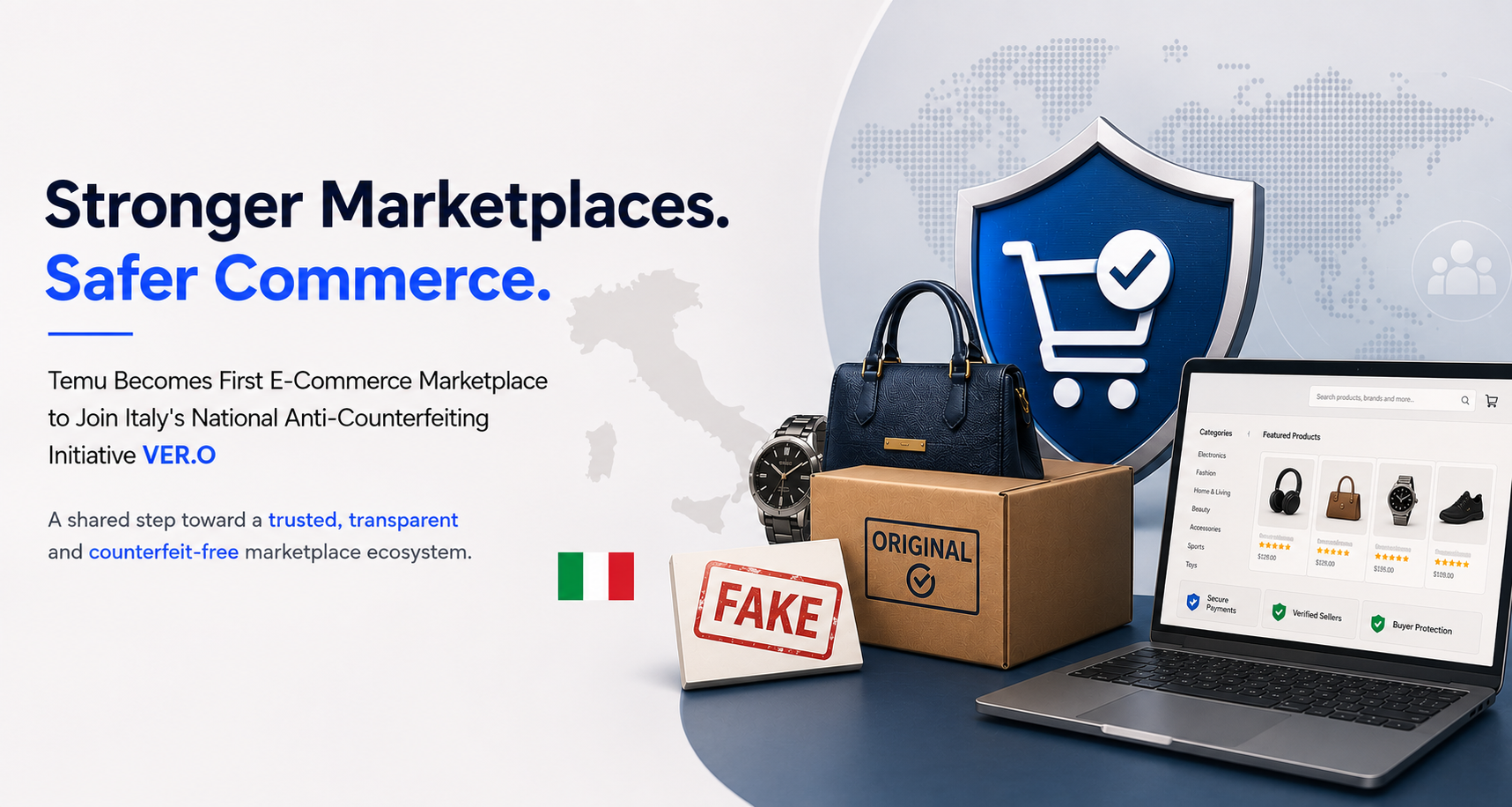
What Temu Has Signed Up For
Temu is the first e-commerce marketplace inside the VER.O framework. That gives it a direct reporting line to CODICI.
The deal also covers teaching, as CODICI and Temu will publish joint guidance on spotting a doubtful listing and reporting it properly.
Ivano Giacomelli, National Secretary of CODICI, said digital commerce is convenient, yet it must rest on safety, transparency and awareness.
Temu presents this as part of a wider European push, citing over 100 meetings and 30 events during the first half of 2026 alone.
The company also sits on the INTA anti-counterfeiting committee. It has signed an MoU with the IACC to deepen the same cooperation.
What This Means for Marketplace Owners
Reporting needs a clear path, because a multi-vendor marketplace has to move a buyer complaint into real seller action.
Onboarding is the earliest control, where seller checks, commission terms and product approval decide who ever reaches your public catalogue.
Bagisto Marketplace Extension ships with admin approval, seller profiles and product review as standard settings.
Records support enforcement, since clean product data, seller identity and order history turn a vague complaint into a case you can act on.
Cooperation is becoming an expectation, as regulators now watch which platforms help by choice rather than waiting for a formal legal order.
Anyone planning a similar build can read our guide on How to Create a Multi Vendor Marketplace before committing a budget.
Read More


Be the first to comment.