Scaling Bagisto for 10 Million Products
Bagisto is an open source eCommerce platform built on Laravel and designed for enterprise-level scalability.
In this article we show how Bagisto handles a catalog of 10 million products, and publish the response times we recorded on a live store running that catalog.
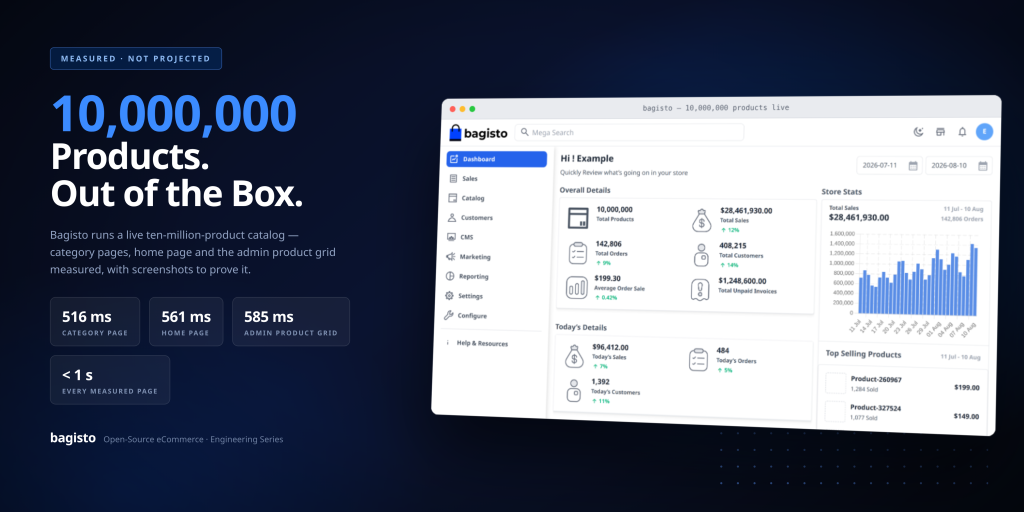
Catalog scale is usually described with adjectives. We would rather show measurements.
We tested Bagisto with 10 million products and measured real performance across shopper pages and daily merchandiser workflows.
The short version: you do not need to fork the core or add a custom storage layer to get here.
Bagisto’s standard indexing architecture, Elasticsearch integration and queue pipeline carry the catalog on their own.
The Numbers: Bagisto Measured at 10 Million Products
Every figure below was recorded on a live Bagisto store holding 10 million products, timing the document request in the browser network panel.
| Measurement @ 10 million products | Response time |
|---|---|
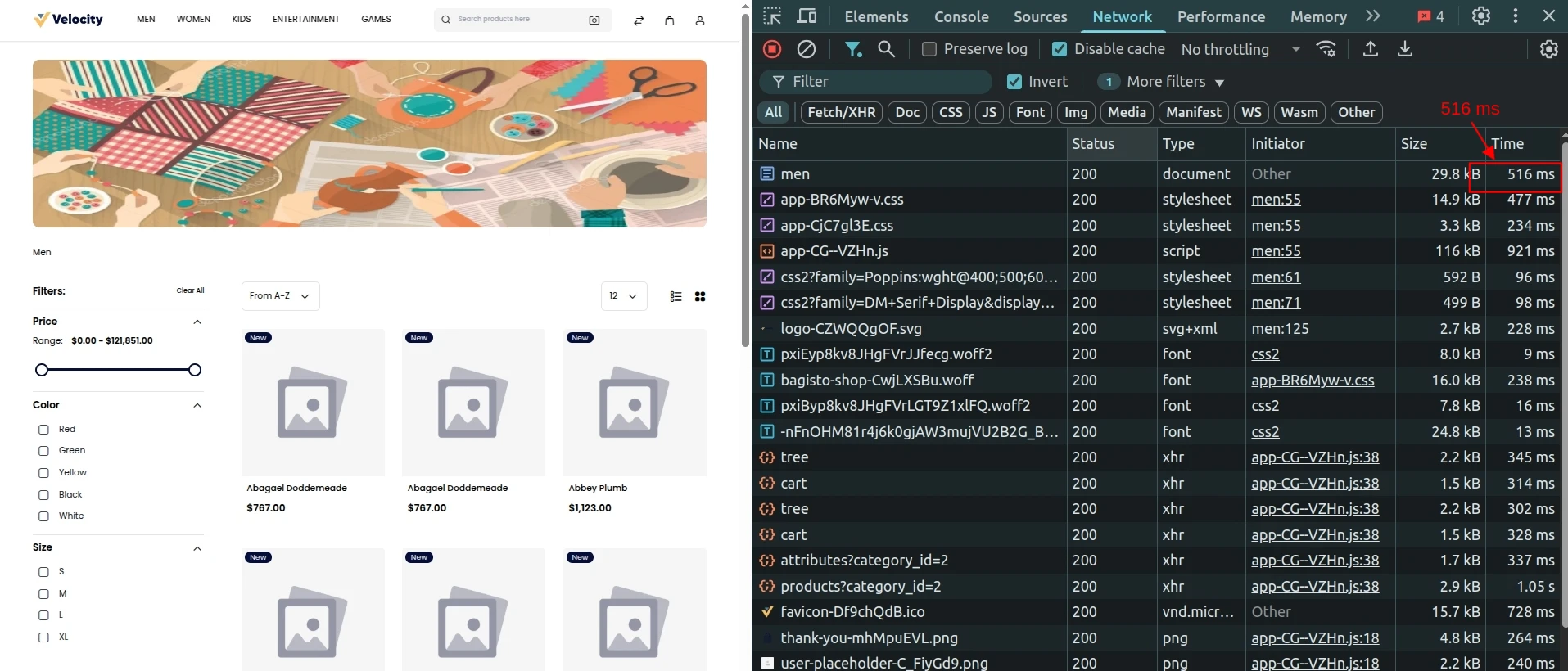
| Storefront category page — listing with filters and sorting | ~516 ms |
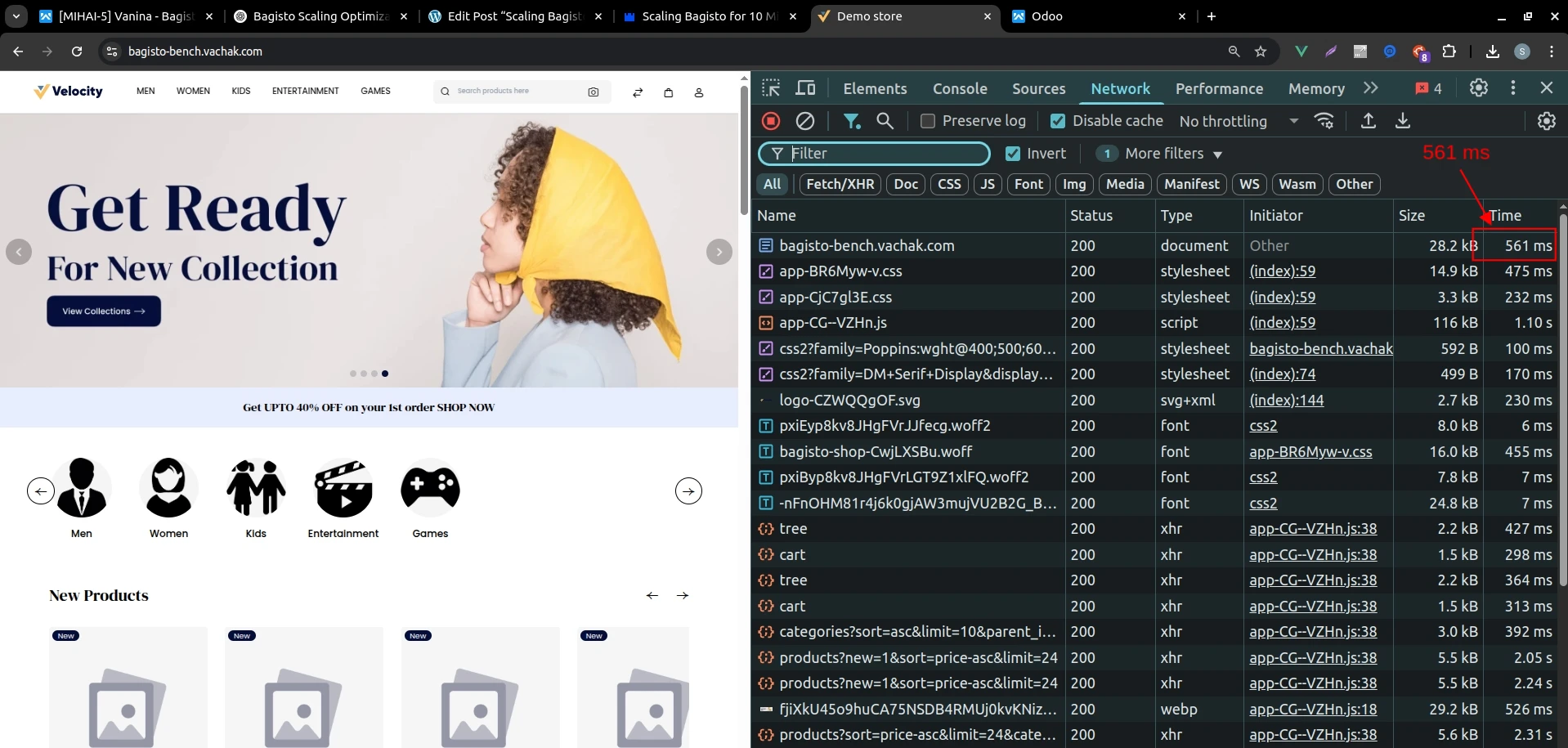
| Storefront home page | ~561 ms |
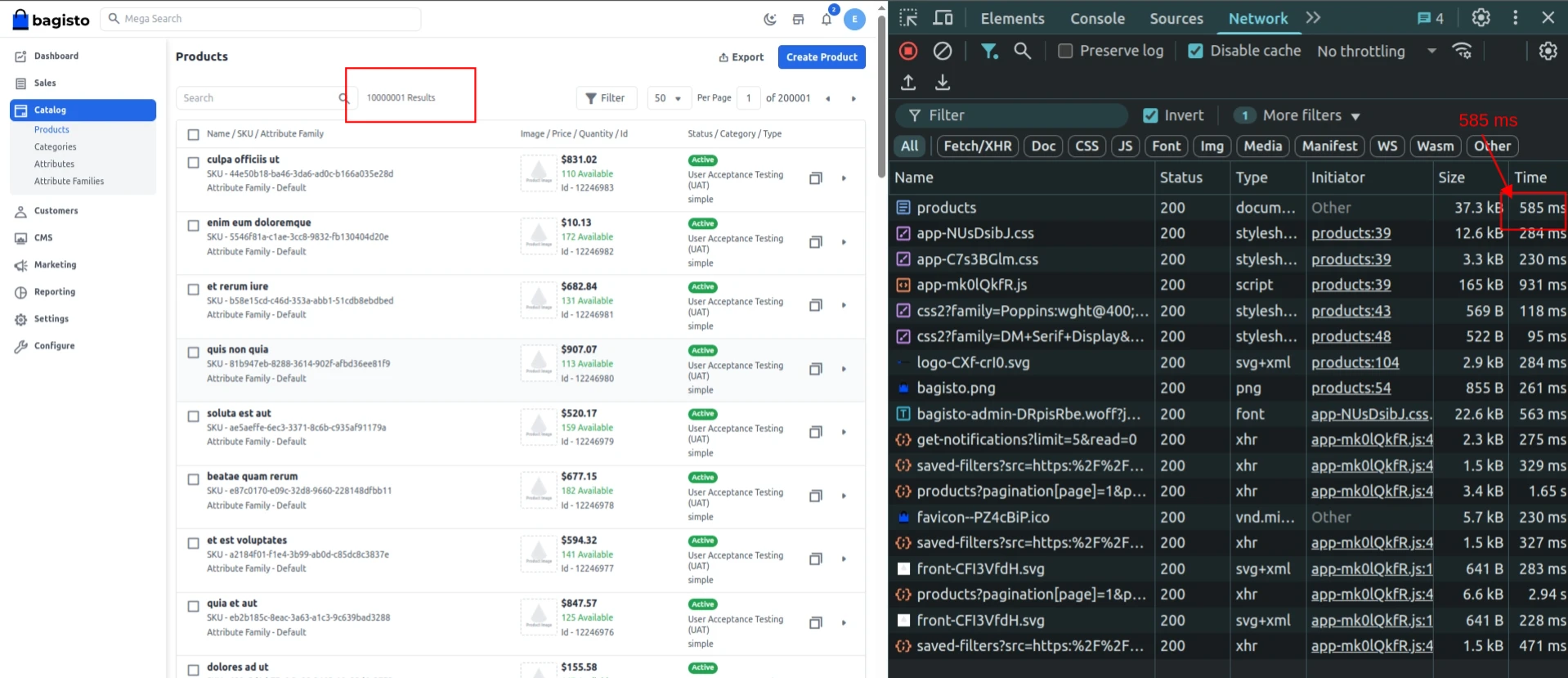
| Admin product grid — 10,000,001 records, paginated | ~585 ms |
Every measured page stays comfortably under one second.
The admin product grid is the most demanding of the three: it pages over a table of ten million rows and still answers in 585 ms.
Note on methodology. Figures are single-run document response times captured in the browser network panel on a live store.
Absolute numbers vary with hardware, cluster sizing and configuration; what matters is that response time stays flat as the catalog grows.
The admin product grid, reporting 10,000,001 products and completing in around 585 milliseconds:
The storefront home page on the same catalog, loading in around 561 milliseconds:
A category page resolving price, stock and attributes for every product in the grid loading in around 516 milliseconds:
How Bagisto Handles 10 Million Products
Performance at this scale is not one optimisation.
Performance comes from four capabilities: pre-indexed data, dedicated search, background queues, and memory-based caching.
The diagram below shows how Bagisto processes customer requests and manages large product catalogs efficiently.
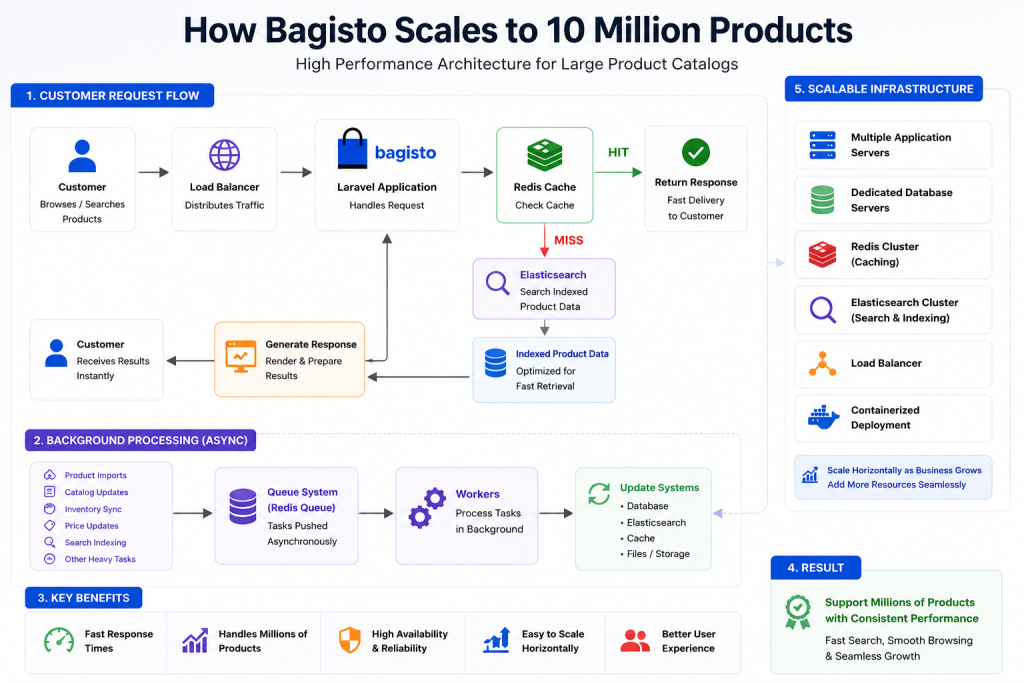
By combining Redis caching, Elasticsearch search, background queues and scalable infrastructure, Bagisto delivers fast performance at scale.
Built-In Indexing Architecture
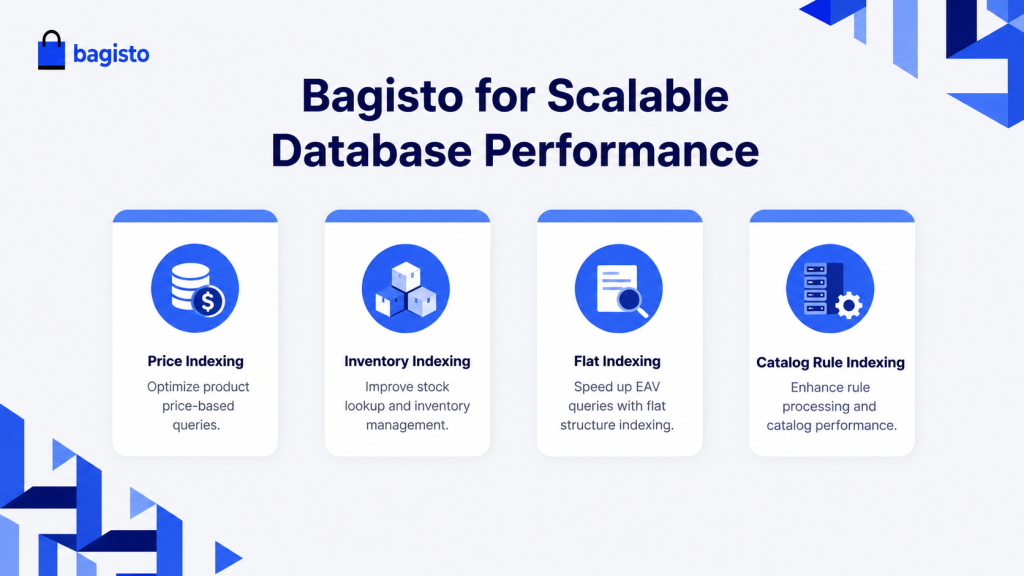
One of the key reasons Bagisto efficiently handles large product catalogs is its indexing architecture.
Rather than repeatedly calculating product information during every storefront request, Bagisto pre-processes and indexes critical data ahead of time.
This allows frequently accessed information to be retrieved quickly and efficiently, in a single fast lookup instead of being rebuilt while a shopper waits.
Category pages stay fast at 516 ms by using prepared records instead of recalculating prices, stock, and attributes for every product.
Enterprise Search
As product catalogs expand, search performance becomes increasingly important.
However, traditional database searches become less efficient when processing millions of products with complex filtering requirements.
To address this challenge, Bagisto provides native integration with Elasticsearch and OpenSearch.
Additionally, search and filtering run on a dedicated search cluster, keeping product discovery fast while reducing the load on the main database.
Real-Time Synchronization
As products are created, updated or removed, Bagisto synchronizes those changes with Elasticsearch.
This ensures customers always receive accurate search results that reflect the latest catalog data, with no manual reindex step in between.
Queue-Based Background Processing
Large eCommerce platforms frequently perform resource-intensive operations such as:
- Product imports
- Data synchronization
- Search indexing
- Catalog updates
- Inventory recalculations
Bagisto leverages a queue system to process these operations asynchronously.
Background processing keeps the storefront responsive, ensuring imports and catalog updates never block shopper requests.
The platform handles heavy operations efficiently at scale, with throughput increased simply by adding more worker processes.
Redis and Advanced Caching Support
Caching plays an essential role in maintaining performance at scale.
Bagisto supports Redis and a caching ecosystem to reduce repetitive database queries and improve response times.
Because the cache is shared across all application nodes, a value computed once on any server benefits every server.
Deployment Reference for 10 Million Products
As business requirements increase, the infrastructure scales horizontally to support growing demand.
Each tier grows independently, so you can size the part that is actually under pressure rather than scaling the whole stack in step.
| Tier | Role | Scales by |
|---|---|---|
| Load balancer | Distributes traffic, terminates TLS, health checks | Active/active nodes |
| Application servers | Stateless storefront rendering and APIs | Add identical nodes |
| Redis cluster | Object cache, sessions, queue backend | Sharding / replicas |
| Search cluster | Full-text and faceted product search | Shards + nodes |
| Database | System of record + read-optimized index tables | Read replicas |
| Queue workers | Indexing, imports, sync, recalculation | Add worker processes |
Bagisto supports scalable deployments with multiple servers, Redis, Elasticsearch, load balancers, and containerized environments.
This architecture enables businesses to expand resources as catalog size and traffic continue to grow.
Tip. Two dials matter most under load, and they are independent of each other.
Application nodes absorb storefront and API traffic, while queue workers absorb imports, reindexing and recalculation.
Size each to its own bottleneck rather than scaling everything together.
Watch this video to scale your eCommerce project for massive growth without sacrificing speed or user experience.
Conclusion
10 million products are achieved through indexed catalogs, Elasticsearch/OpenSearch search, queued operations, and scalable platform design.
Bagisto serves 10 million products quickly on an open-source core, allowing businesses to scale catalogs while maintaining a reliable shopping experience.
Thanks for reading this guide. If you have questions about running Bagisto at scale, leave a comment, as we are here to help.
If you have questions or need help with your eCommerce project, feel free to contact our team.
Additionally, explore more Bagisto extensions, tools, and resources on the official Bagisto website.


Be the first to comment.