Build your own headless eCommerce site with React/Next.js and Bagisto
Modern eCommerce businesses need platforms that are flexible and easy to scale.
Headless eCommerce site platforms helps brands build fast and customizable online stores.
Let’s explore how to combine React, Next.js, and Bagisto to build a fast, SEO-friendly, and fully customizable headless eCommerce solution.
In a headless setup, the frontend and backend work independently. This gives developers more freedom to design better user experiences.
Developers can use modern tools to build simple and responsive storefronts. These tools also help improve site speed and overall performance.
Frameworks like React.js and Next.js enable developers to build highly interactive websites.
Meanwhile it also improving performance and ensuring faster page load times.
Users have access to a wide range of UI development technologies for their eStores, such as eCommerce development with React.js.
When used with Bagisto, these tools help create strong headless eCommerce site. Businesses can build modern and scalable online stores more efficiently.
What is Headless eCommerce?
Headless eCommerce is when the part you see on the website (the frontend) is different from the part that runs the online store (the backend).
The frontend talks to the backend using special tools called APIs, like GraphQL or REST.
This setup lets developers create unique shopping experiences without messing with the backend system.
Companies can share their content on websites, mobile apps, kiosks, and marketplaces, all from one backend platform.
Headless commerce is also a key part of the new way of doing business called composable commerce architecture.
Why choose React.js / Next.js for Headless eCommerce?
React.js and Next.js are popular frameworks for building websites today. They allow developers to create quick and engaging user interfaces with reusable parts.
Next.js brings in strong features like server-side rendering, static generation, and API routes.
These features enhance website performance, help with SEO, and allow for growth.
A lot of new headless stores are made with Next.js because it is flexible and fast. It’s a key part of modern composable commerce architecture.
Next.js Features for Headless eCommerce
- Image Optimization
Next.js has tools for optimizing images built right in. It automatically resizes images and serves them in modern formats.
This makes pages load faster and improves the user experience. Optimized images also help boost Core Web Vitals scores.
- Incremental Static Regeneration
With Incremental Static Regeneration, developers can update pages without having to rebuild the whole website.
Product pages can change automatically when inventory or prices change.
This method keeps websites fast and able to grow. It’s commonly used in big eCommerce product catalogs.

- Built-In CSS Support
It allows you to import CSS files from a JavaScript file. This is done because Next.js extends the concept of import beyond JavaScript.
They can also use modern styling frameworks like Tailwind CSS. This makes UI development easier and helps keep the code organized.
-
Code-splitting and Bundling
Next.js automatically divides JavaScript into smaller bundles. Only the code needed for each page loads.
This greatly enhances performance and loading speed.

- API Routes
Next.js has built-in API routes for backend features. Developers can create APIs easily without needing a separate server.
This approach simplifies full-stack development by keeping both frontend and backend logic in one place, making the application easier to manage and scale.
- Core Web Vitals
Core Web Vitals measure how real users experience a website. These metrics help developers see how well pages perform and stay stable.
Core Web Vitals include three important metrics.
- The Largest Contentful Paint (LCP) looks at the loading performance of your page.
- The First Input Delay (FID) metric is the opinion of an end user’s experience while interacting with a web page.
- While the Cumulative Layout Shift (CLS) metric is a measure of your site’s overall layout stability.

Why power eCommerce with a Headless Platform like Bagisto?
Bagisto is an open-source eCommerce platform built on Laravel. It provides backend capabilities for managing products, orders, and customers.
When used as a headless commerce backend, Bagisto powers the business logic while the frontend handles the user experience.
Developers can build modern storefronts using frameworks like React, Next.js, or Vue. This separation allows faster development and easier customization.
Why Pick Bagisto for Headless Commerce?
Bagisto offers the strength of open-source headless commerce with complete flexibility.
Developers can quickly create, change, and grow their online shops according to what the business needs.
Bagisto comes with GraphQL and REST APIs for straightforward integration.
These APIs enable easy integration with current frontend frameworks and other tools.
Bagisto Headless Commerce helps businesses:
- Build custom storefronts
- Improve page loading performance
- Increase SEO performance
- Manage products and inventory easily
- Handle millions of SKUs
- Scale the platform as the business grows
- Use ready extensions such as Stripe, PayPal, and shipping integrations
Advantages of Using Bagisto Headless Commerce
Faster Performance
Headless commerce sends store data through APIs. This helps pages load fast and gives users a smooth shopping experience.
Easy Customization
Developers have full control over the frontend. This makes it easier to create unique store designs and features.
Omnichannel Experience
One backend can support many platforms. These include websites, mobile apps, and other digital channels.
Trending Technologies in Headless Commerce
GraphQL APIs
GraphQL lets apps request only the data they need. This reduces extra API calls and improves performance.
Composable Commerce
Composable commerce helps businesses connect different tools. These can include CMS, search, payments, and analytics.
Edge Performance and Caching
Modern stores use CDN networks and caching tools. These help websites load faster for users around the world.
AI-Powered Personalization
AI studies user behavior and preferences. It then shows products that match customer interests.
How to Build a Headless Store with Bagisto Headless Commerce
Step 1: Install Bagisto
First, install the Bagisto eCommerce platform.
Visit the official installation guide to follow the setup steps.
You can install it on Windows, Mac, or Linux systems.
Once installed, you will be able to access your store admin panel.
Tip: Ensure your server includes PHP 8.x, MySQL 8.x, and Composer.
Step 2: Install the Headless Extension
After installing Bagisto, install the Bagisto Headless Extension.
This extension provides APIs required for frontend communication.
Follow the official documentation to install it.
After installation, your APIs will be available at:
|
1 |
http://localhost/graphql |
These APIs let your frontend fetch products, categories, and other store data.
Step 3: Set Up Your Storefront Quickly
Bagisto headless eCommerce site allows developers to quickly create storefronts.
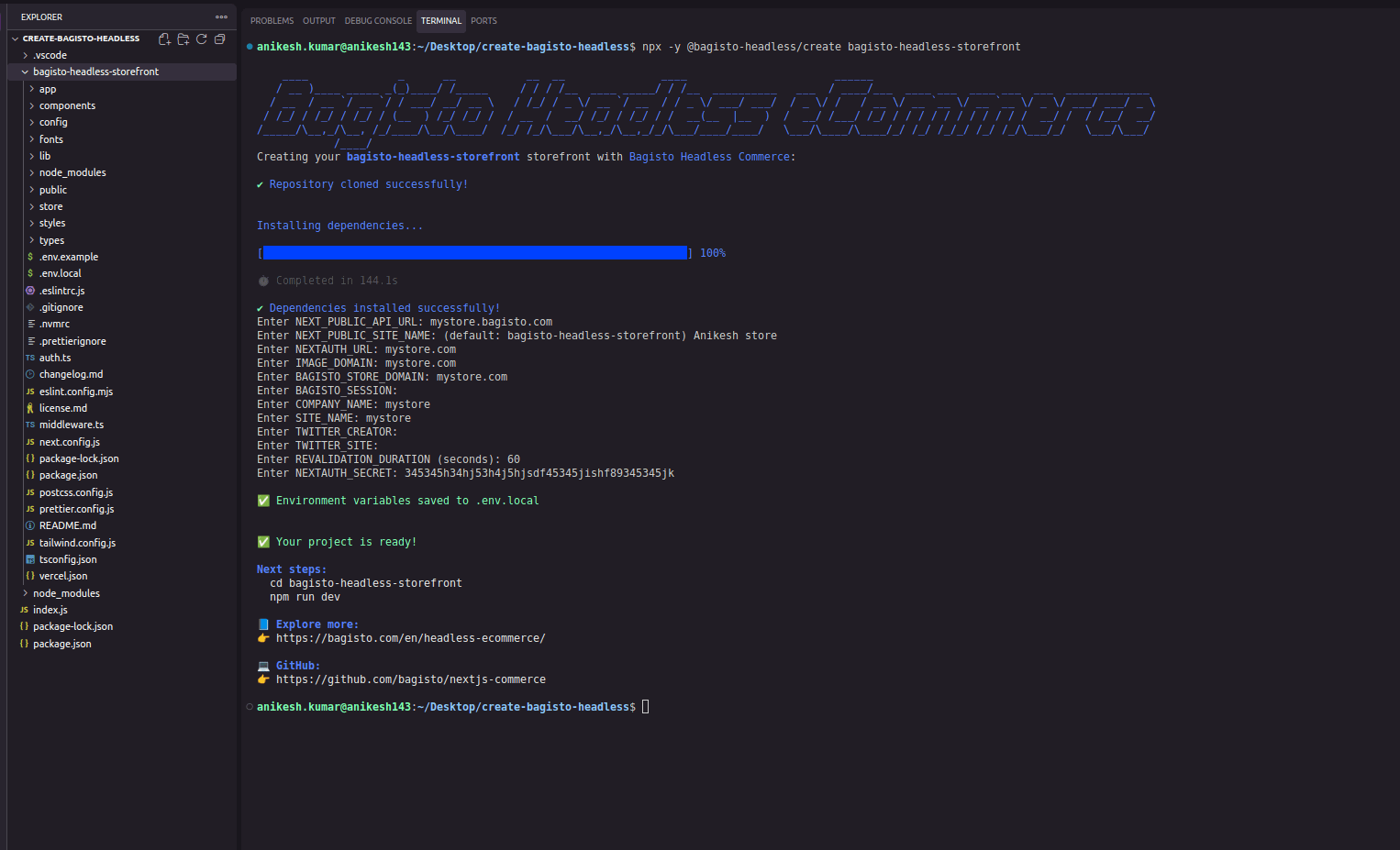
Run the following command:
|
1 |
npx -y @bagisto-headless/create your-storefront |
This command will:
- Install all required dependencies
- Configure the project environment
- Prepare your storefront project automatically
Within a few minutes, your storefront will be ready.
Step 4: Test Your Bagisto Headless Store
After installation, open your storefront in the browser.
Verify that the store loads correctly.
Check whether products and categories display correctly.
Test whether the GraphQL API returns correct data.
If everything works correctly, your Bagisto headless eCommerce site setup is complete.
For step-by-step installation guidance, you can refer to the link provided.
Configuration
For configuring, you need to first configure the Bagisto store with headless.
Set up Bagisto Store
- You need to install the Bagisto.
- Then, you need to install the Bagisto Headless Extension in the Bagisto.
- Now you need to host the full application so that you have a store endpoint, and if you are in development mode, then you can also use Ngrok.
- After that, you can proceed with setting up Next.js commerce.
Set up Vercel Commerce Provider
After setting up the Bagisto Store with the Headless extension, you need to set up the Vercel Commerce provider.
You have to take a clone of the repo Next.js Commerce.
Open the site/.env.local and change the value of
COMMERCE_PROVIDER to @vercel/commerce-bagisto,
Then set the environment variables for the Bagisto provider (use site/.env.template as the base).
The setup for Bagisto would look like this, for example:
|
1 |
COMMERCE_PROVIDER=@vercel/commerce-bagisto |
Now set the fields-
|
1 2 3 |
BAGISTO_CURRENCY_CODE=INR BAGISTO_STORE_ENDPOINT=https://example.bagisto.com/graphql |
After that, you’re all set to go to use the headless eCommerce site with React/Next.js and Bagisto.
Final Thoughts
Headless commerce is a popular choice for building fast and flexible eCommerce stores. Tools like React, Next.js, and Bagisto simplify development.
With full frontend control and a strong backend, along with technologies like GraphQL and AI, businesses can create scalable and future-ready online stores.
It also allows businesses to quickly adapt to changing market needs and deliver consistent experiences across multiple platforms.
So, that was much about “Build your own headless eCommerce site with React/Next.js and Bagisto”.
For any queries or doubts, reach out to us at [email protected]. You can also raise a ticket at our HelpDesk System.


Be the first to comment.