Scaling Bagisto Marketplace Platform to 10 Million+ Products
Bagisto Marketplace transforms a single-vendor Bagisto store into a scalable multi-vendor marketplace built on Laravel.
Growing marketplaces require fast product discovery, responsive seller dashboards, and efficient order processing to deliver a seamless experience.
In this article, we show how Bagisto Marketplace supports catalogs of over 10 million products and share the load times we recorded across the platform.
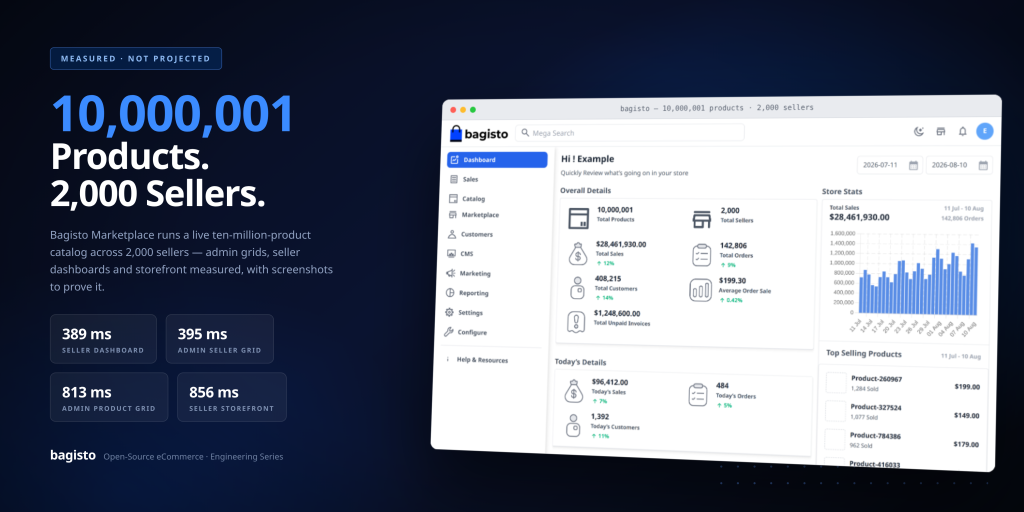
Marketplace scale is usually described with adjectives. However, we prefer to show real measurements.
Therefore, we loaded a Bagisto Marketplace instance with 2,000 sellers and 10,000,001 products.
We then measured the four most important surfaces: the two admin grids used by operators, the seller dashboard, and the storefront used by customers.
The Numbers: Bagisto Marketplace Measured at 10 Million Products
To evaluate real-world performance, we tested Bagisto Marketplace with 2,000 sellers and 10,000,001 products.
The following benchmarks were recorded from different areas of the platform.
| Surface measured | Scale under test | Load time |
|---|---|---|
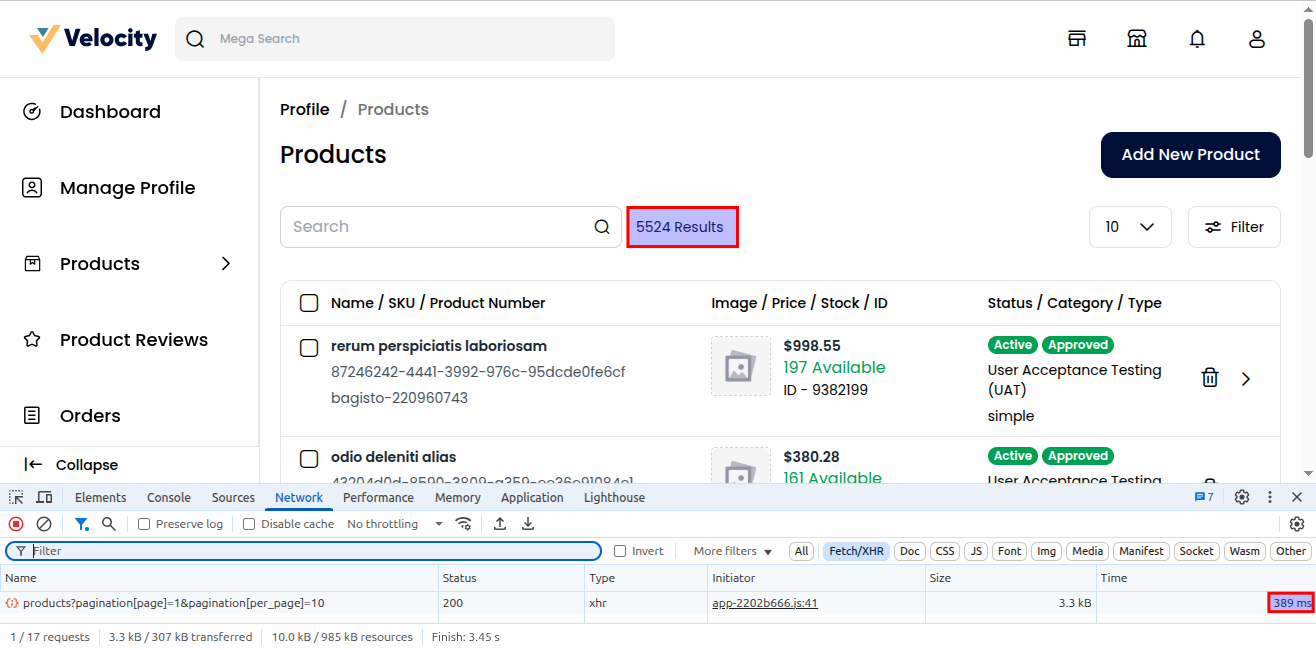
| Seller dashboard | 5,500+ products for one seller | ~389 ms |
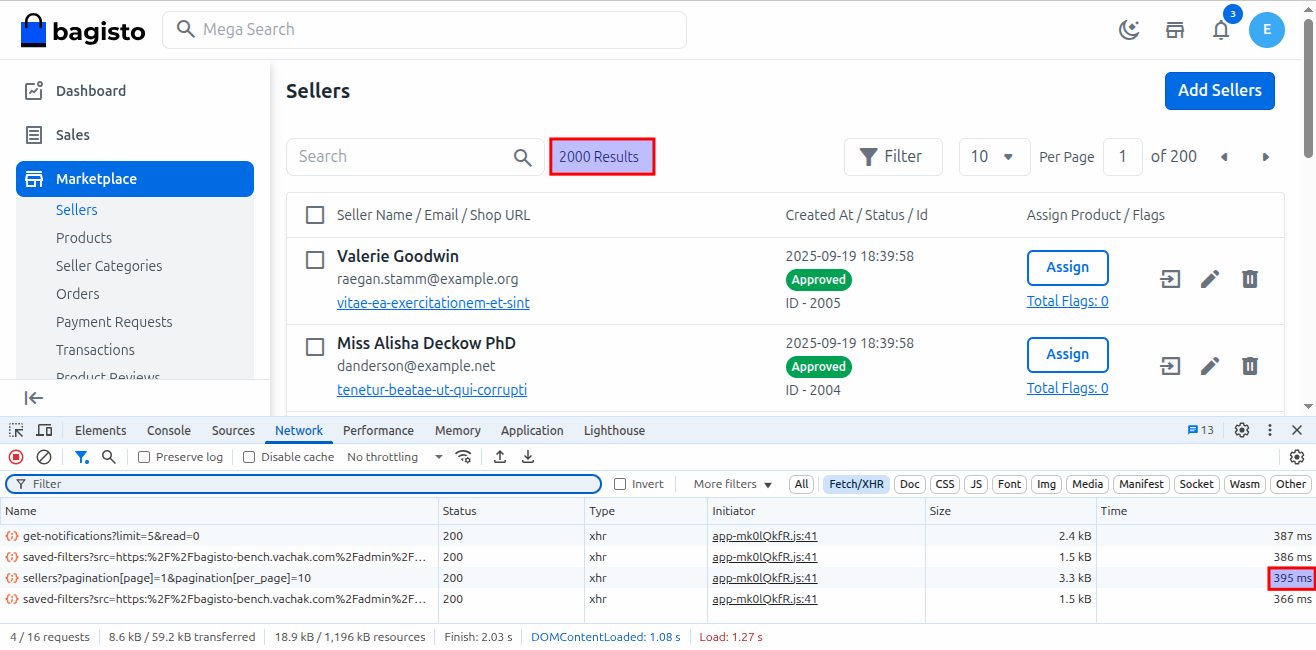
| Admin seller listing | 2,000 sellers | ~395 ms |
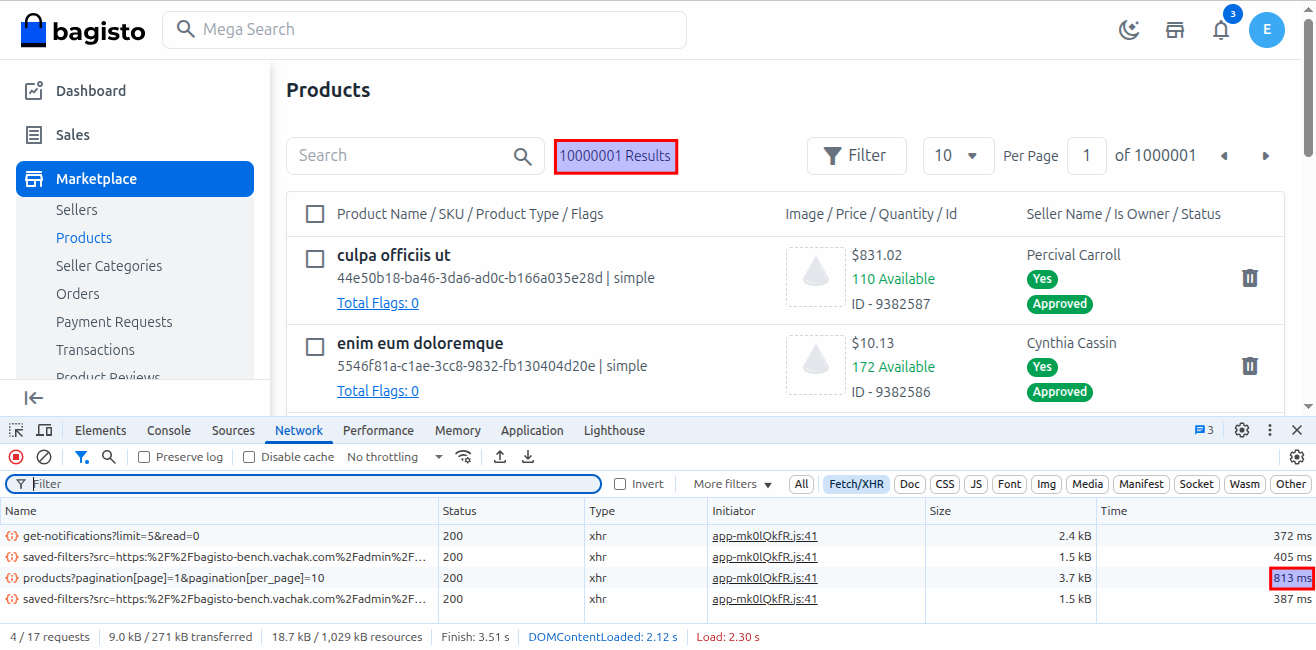
| Admin product listing | 10,000,001 products | ~813 ms |
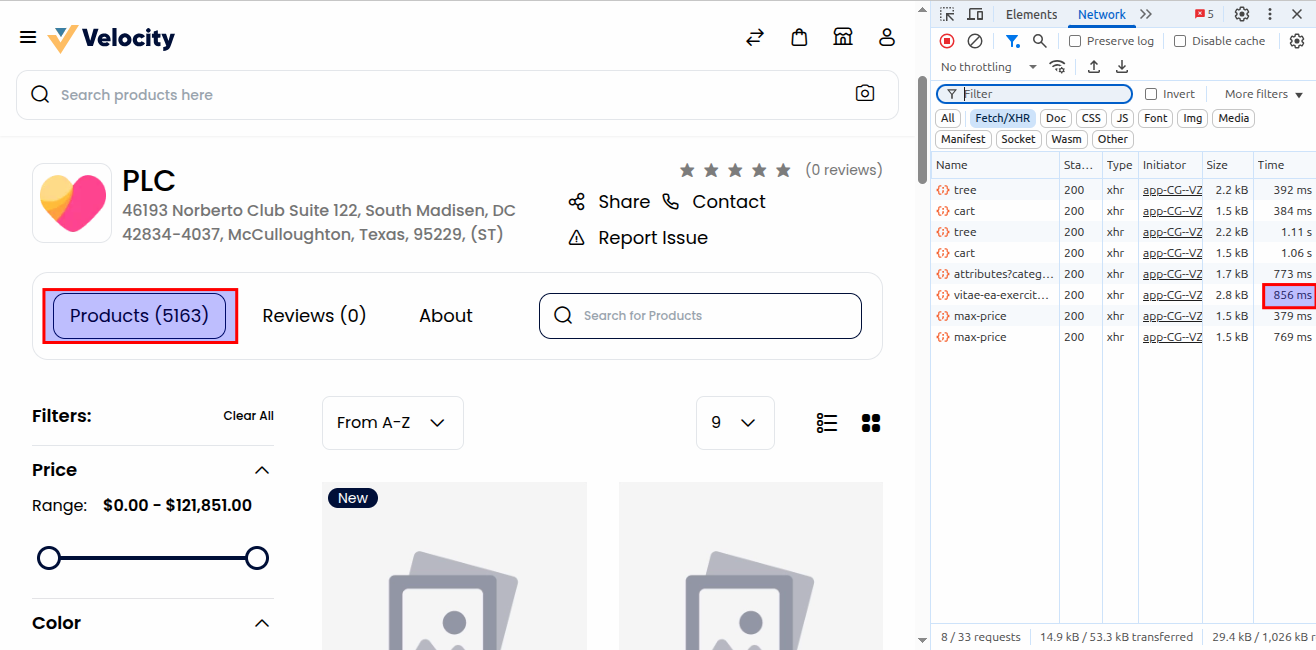
| Seller storefront | 5,100+ products for one seller | ~856 ms |
These benchmarks demonstrate that both administrative operations and customer-facing storefronts remain responsive even with extremely large product catalogs.
The admin product listing is the most demanding of the four: it pages over a table of more than ten million rows and still answers in 813 ms.
Note on methodology. Figures are page load times recorded on a live Bagisto Marketplace instance with 2,000 sellers and 10,000,001 products.
The Marketplace seller grid, containing 2,000 sellers, loaded in approximately 395 milliseconds:
The Marketplace product grid, containing 10,000,001 products, loaded in approximately 813 milliseconds:
A seller managing more than 5,500 products saw dashboard load times of approximately 389 milliseconds:
A public seller storefront displaying more than 5,100 products loaded in approximately 856 milliseconds:
Built on Bagisto’s Scalable Architecture
One of the biggest advantages of Bagisto Marketplace is that it inherits Bagisto’s enterprise-ready architecture.
Rather than calculating catalog data on every request, Bagisto preprocesses and indexes the data ahead of time.
This approach improves performance and reduces database overhead.
The sections below cover the six capabilities that produce the numbers above.
Efficient Database Performance
Large marketplaces generate millions of records for products, pricing, inventory and vendor relationships.
Bagisto minimizes database overhead through several built-in optimization strategies:
- Optimized Eloquent relationships to reduce unnecessary queries
- Batch processing for large catalog updates
- Read/write database separation for high-traffic deployments
- Efficient indexing of frequently accessed product data
These optimizations help maintain consistent performance as the marketplace continues to grow.
Built-In Product Indexing
Bagisto uses dedicated indexers to preprocess catalog information before it reaches the storefront.
This allows frequently accessed product data to be retrieved quickly instead of being recalculated for every request.
The platform maintains indexes for:
- Product pricing
- Inventory availability
- Catalog rules
- Product attributes
- Channel and locale data
This indexing architecture plays an important role in supporting catalogs with millions of products.
It helps keep the admin product grid response time at 813 ms, even with 10 million rows.
Enterprise Search with Elasticsearch
Searching millions of products efficiently requires more than traditional SQL queries.
Bagisto provides native integration with Elasticsearch and OpenSearch, enabling:
- Fast full-text product search
- Attribute-based filtering
- Price filtering
- Vendor filtering
- Scalable search across millions of products
As marketplaces expand, search performance remains fast and accurate without placing unnecessary load on the primary database.
Real-Time Catalog Synchronization
Product updates are automatically synchronized with the search index to keep results accurate.
Ensures accurate search, updated product availability, consistent seller storefronts, and a better customer experience.
Queue-Based Background Processing
Large eCommerce platforms frequently perform resource-intensive operations, including:
- Product imports
- Inventory updates
- Search indexing
- Catalog synchronization
- Bulk product updates
Bagisto processes these operations asynchronously using Laravel queues.
Background processing keeps storefront requests fast while large catalog operations run efficiently.
This ensures that a seller performing a bulk import does not slow down another seller’s storefront.
Redis and Advanced Caching
Bagisto supports Redis and Laravel’s caching system to reduce repetitive database queries and improve response times.
Deployment Reference for a 10 Million Product Marketplace
As marketplaces continue to grow, additional infrastructure can be introduced without changing the application architecture.
Each tier scales on its own, so you can size the part that is actually under pressure rather than scaling the whole stack together.
| Tier | Role | Scales by |
|---|---|---|
| Load balancer | Distributes traffic, terminates TLS, health checks | Active/active nodes |
| Application servers | Storefront, seller dashboards and admin | Add identical nodes |
| Redis cluster | Object cache, sessions, queue backend | Sharding / replicas |
| Search cluster | Full-text, attribute, price and vendor filtering | Shards + nodes |
| Database | Products, pricing, inventory, vendor relationships | Read/write separation, read replicas |
| Queue workers | Imports, indexing, synchronization, bulk updates | Add worker processes |
This allows businesses to scale both traffic and catalog size with confidence.
Conclusion
Ten million products across two thousand sellers is not a hosting tier.
It is the result of design decisions inherited from the Bagisto core.
Catalog data is indexed ahead of time, search is handled by Elasticsearch or OpenSearch, and heavy operations are processed in the background.
Redis serves repeated requests quickly, while each tier can scale independently.
The measurements above show what those decisions deliver.
Bagisto is designed to grow with your business.
Whether you are building a niche marketplace or an enterprise platform, Bagisto provides the foundation needed to scale confidently.
If you have questions or need help with your eCommerce project, feel free to contact our team.
Additionally, explore more Bagisto extensions, tools, and resources on the official Bagisto website.


Be the first to comment.