Composable Commerce vs Headless Commerce
The eCommerce is changing fast. Speed and flexibility decide who stays ahead.
Brands are moving away from slow, monolithic systems. They’re choosing modular, API-driven setups instead.
Two big ideas lead this change: Headless Commerce and Composable Commerce. They sound similar but mean different things.
Knowing when to use each can shape your next decade of growth. Let’s break down how they work and which one fits your business best.
What Is Headless Commerce?
Headless Commerce is an eCommerce architecture where the frontend (presentation layer) is separated from the backend (business logic and data layer).
This separation happens through APIs, allowing developers to build unique, flexible storefronts using frameworks like React, Vue, or Next.js, while still using a backend platform such as Bagisto, Magento, or Shopify.
You can check this blog in detail on how we can implement headless architecture.
Think of it as: “Decoupled, but not entirely modular.”
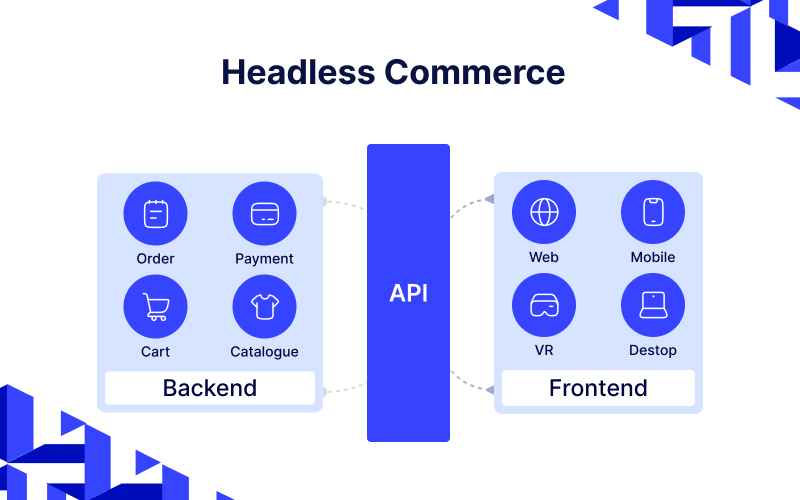
Key Features of Headless Commerce
- API-driven: All communication happens via REST or GraphQL APIs.
- Frontend freedom: You can use any frontend technology like web, app, or kiosk.
- Decoupled development: Teams can build and deploy frontend and backend separately.
- Omnichannel-ready: Enables consistent shopping experiences across multiple touchpoints.
-
Future-proof stack: Upgrade or replace any layer (frontend, backend, service) independently.
-
Enhanced security: Isolated frontend and backend layers improve data and API security.
-
Reusable backend services: The same APIs can serve multiple storefronts, apps, or marketplaces.
-
Gradual migration: Transition from a monolithic platform to headless in phases, minimizing risk.
-
Microservice-compatible: Perfect for modular and enterprise-level eCommerce architectures.
Benefits of Headless Commerce
- Flexibility: Design completely custom user interfaces.
- Faster innovation: Deploy frontend updates without backend interference.
- Performance optimization: Use modern frameworks like Next.js for blazing-fast UX.
- Better personalization: Integrate advanced marketing or analytics tools directly into the frontend.
What Is Composable Commerce?
Composable Commerce takes headless a step further.
It’s a modular architecture where every business capability like product catalog, cart, checkout, CMS, search, and analytics, is a separate, best-of-breed microservice, all connected via APIs.
Think of it as: “Headless on steroids, modular, replaceable, and infinitely scalable.”
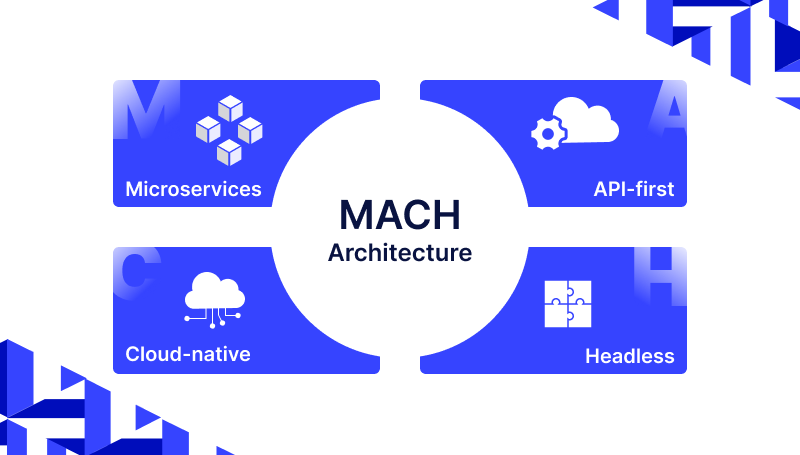
This approach follows the MACH principles:
- Microservices
- API-first
- Cloud-native
- Headless
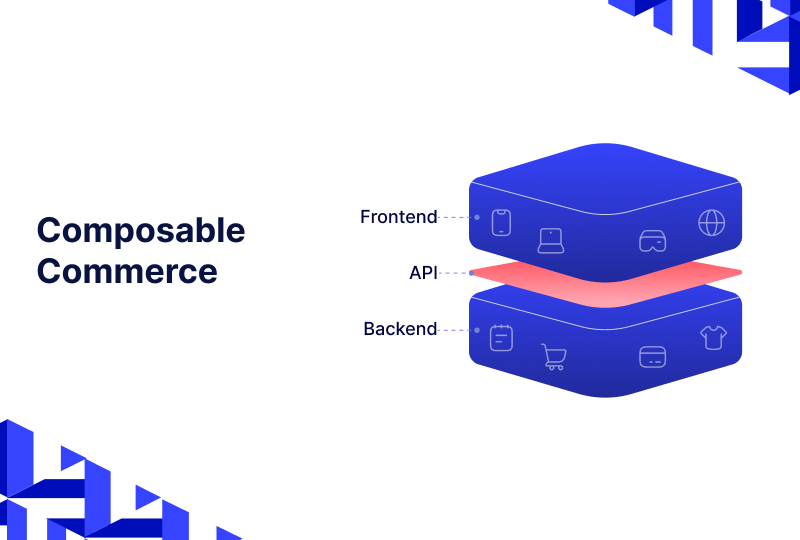
Key Principles of Composable Commerce
- Modularity: Each function (search, pricing, checkout) is an independent service.
- Replaceability: Swap services anytime without affecting others.
- Scalability: Scale each microservice separately.
- Best-of-breed integration: Combine the best vendor for every need — Algolia for search, Stripe for payments, etc.
Benefits of Composable Commerce
- Business agility: Quickly add or replace vendors and tools.
- Future-proofing: Adopt new technologies without full system rebuilds.
- Cost efficiency at scale: Pay only for the services you use.
- Global scalability: Handle traffic spikes by scaling microservices independently.
- Truly omnichannel: Power web, app, POS, and IoT experiences seamlessly.
Composable Commerce vs Headless Commerce: The Core Difference
| Feature | Headless Commerce | Composable Commerce |
|---|---|---|
| Architecture | Decoupled frontend & backend | Modular microservices |
| Integration | Single backend via APIs | Multiple API-first services |
| Scalability | Limited to backend’s capability | Scales per service |
| Flexibility | Flexible frontend | Fully flexible across all layers |
| Vendor Lock-in | Possible | Minimal (vendor-agnostic) |
| Ideal For | Fast UI customization | Complex, evolving ecosystems |
In short:
Headless = Frontend freedom Composable = Complete freedom
When to Choose Headless Commerce
Go headless when:
- You’re using an existing eCommerce platform (like Bagisto, Magento or Shopify).
- You need faster frontend innovation without backend overhauls.
- You want to improve site performance and UX with React/Next.js.
When to Choose Composable Commerce
Choose composable when:
- You’re scaling globally with complex operations.
- You need deep customization across all business functions.
- You want to future-proof your stack with MACH technologies.
- You prefer a vendor-agnostic, API-first ecosystem.
Technical Architecture Comparison
Headless Architecture Example:
- Backend: Bagisto / Shopify / Magento
- API Layer: REST or GraphQL
- Frontend: Next.js / React
- CMS: Headless CMS like Contentful
- Search: Integrated from backend
Composable Architecture Example:
- Product Service: CommerceTools
- Checkout Service: Custom microservice
- CMS: Storyblok or Sanity
- Search: Algolia
- Payment: Stripe
- Personalization: Bloomreach
Each service communicates via secure APIs and can be replaced independently.
Real-World Examples
- Headless Example:
Nike.com uses a React-based frontend with a custom backend API layer. - Composable Example:
Lego and Mars use Commercetools + Contentstack + Algolia + Stripe in a modular setup.
How Composability Powers Omnichannel Experiences
Composable commerce makes omnichannel effortless:
- Build once, deploy across web, app, POS, and kiosks.
- Manage product data centrally but distribute it anywhere via APIs.
- Deliver consistent experiences across all touchpoints.
The Role of MACH Architecture
MACH (Microservices, API-first, Cloud-native, Headless) is the technical foundation of composable commerce.
It ensures scalability, agility, and future-readiness — enabling enterprises to innovate faster and integrate emerging tools like AI-driven personalization and AR shopping experiences.
Challenges and Considerations
- Higher initial complexity: Requires strong architectural planning.
- Integration management: More APIs = more orchestration effort.
- Team expertise: Developers must be familiar with microservices and DevOps.
Future Trends in Composable and Headless Commerce
- AI-driven personalization across microservices.
- Low-code orchestration layers to manage multiple APIs.
- Unified data models for analytics across channels.
- Open-source composable stacks gaining popularity (like Bagisto Headless Commerce and Medusa.js).
Conclusion
Headless commerce was the first major leap toward flexibility, freeing the frontend.
Composable commerce is the next evolution, freeing the entire stack.
If you’re a growing brand or enterprise aiming for core webvital and speed, scalability, and innovation, composable commerce is your future.
But if you’re transitioning gradually or experimenting with frontend flexibility, start with headless and evolve toward composability.


Be the first to comment.