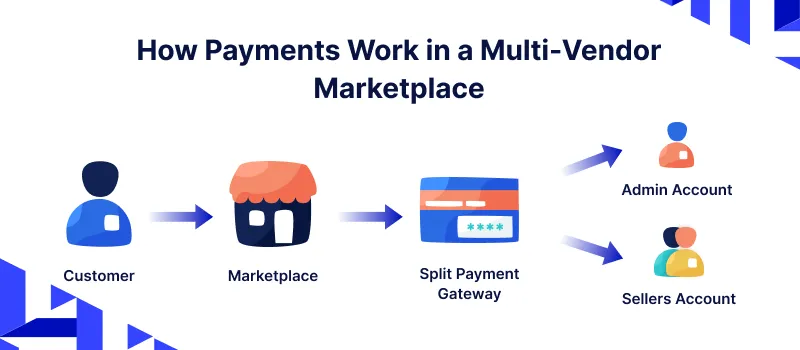
When a customer completes payment, the marketplace deducts its commission and instantly sends the remaining amount to the vendor.
Split payments automatically divide what customers pay between the marketplace owner and the vendors on a multi vendor marketplace platform.
When a customer makes a purchase from different sellers in a single order, the system takes care of distributing the payments without any mix-ups.
Instead of sending full payment to the marketplace and paying vendors later, the amount is split instantly based on commission rules.
This removes manual work and reduces accounting errors.
Automated split payments make things clearer, speed up how quickly vendors get paid, and help the marketplace run smoothly.
They also assist platforms in managing their revenue in a safe and organized manner.
This guide will explain how split payments function and why they are essential for marketplace businesses.
What Are Split Payments?
Split payments let a marketplace break down the money from one order into different parts.
The money is shared between the marketplace owner and the vendors automatically.
Rather than sending the whole payment to the admin and paying the vendors later, the money is shared right away after the transaction is done.
This makes payouts quicker and more efficient.
For example:
When a buyer spends ₹2,000 on items, the marketplace applies the 10% global commission set by the admin.
In this case, ₹200 is calculated as the admin’s commission.
The remaining ₹1,800 is transferred to the seller automatically. This keeps the payment process simple, transparent, and easy to manage.
Why Splitting Payments Matters for Marketplace Platforms
Easy Commission Management
The commission setup is a key way for marketplace businesses to make money.
With split payments, commissions are taken out right away, which means the platform gets its income without needing to do any math.
Quicker Payments for Vendors
Fast payments make vendors happier. Sellers like platforms that have dependable payment systems.
Less Complicated Accounting
When payouts are done manually, it involves a lot of work, like checking balances, transferring money, keeping track, and making reports.
Using automated split payments makes the financial tasks easier.
More Transparency
Everyone can see how the earnings are divided:
- The product price
- The platform’s commission
- Taxes
- Fees from the payment gateway
- Clear systems build trust among sellers.
Growth for Big Marketplaces
As the number of vendors increases, it gets harder to distribute funds manually. Automating split payments helps marketplaces grow.
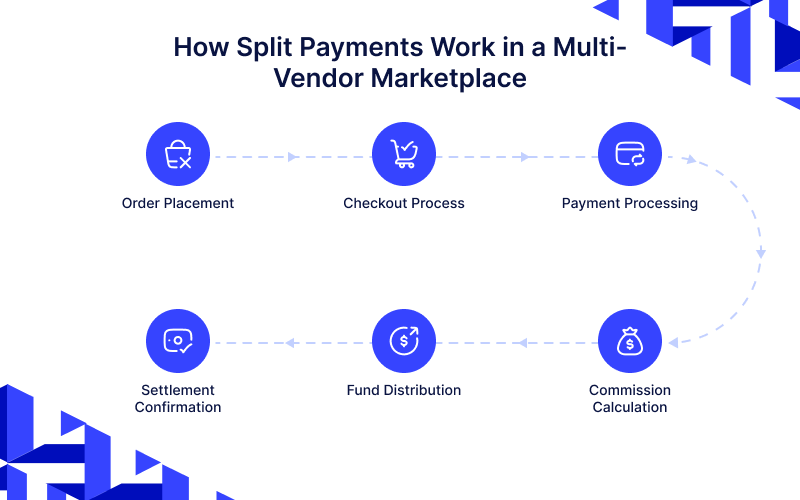
How Split Payments Work in a Multi-Vendor Marketplace
The split payment process has a clear workflow:
Step 1: Order Placement
A customer puts products from one or more vendors into their cart.
Step 2: Checkout Process
The customer finishes the payment using the integrated payment gateway.
Step 3: Payment Processing
The gateway securely processes the total amount.
Step 4: Commission Calculation
The system figures out:
- Marketplace commission
- Vendor share
- Applicable taxes
- Transaction fees
Step 5: Fund Distribution
The payment gateway automatically divides the funds and sends:
Commission to the marketplace account
The remaining balance to the vendor accounts.
Step 6: Settlement Confirmation
Both the admin and the vendor get a confirmation of the transaction.
This automated workflow makes managing payments in the marketplace efficient.
Types of Split Payment Models
In a marketplace with many vendors, split payment models explain how and when money is shared between the marketplace admin and the vendors.
Picking the right model depends on what kind of business you have, how much risk you’re willing to take, and how your operations are set up.
There are two main types of split payment models:
Instant Split Payment
In the Instant Split Payment model, money is automatically split between the marketplace and the vendors right after a customer makes a successful purchase.
Best For:
- Physical product marketplaces
- Digital product platforms
- Subscription-based marketplaces
Advantages:
- Real-time settlement
- No money holding or payout delays
- Faster revenue recognition
- Better cash flow for vendors
- Automated and clear transactions
This model is best when the chances of refunds or disputes are low and delivery times are reliable.
Escrow-Based Split Payment
In the escrow-based split payment model, the full payment is collected and held temporarily until specific conditions are met.
Funds are released only after delivery confirmation or successful service completion; once verified.
The marketplace deducts its commission and transfers the remaining amount to the vendor.
Best For:
- Service marketplaces
- Freelance platforms
- High-value product sales
- Custom or made-to-order products
Advantages:
- Strong buyer protection
- Fewer refund and chargeback disputes
- Controlled payout release
- More trust between buyers and sellers
- Better management of disputes
This model is perfect for businesses where confirming delivery, ensuring service quality, or completing projects is very important.
Split Payments and Compliance Requirements
Marketplace platforms need to follow these rules:
- Tax laws (like GST and VAT)
- KYC checks for sellers
- Anti-money laundering regulations
- Policies for handling chargebacks
New payment systems come with compliance help to lower legal risks.
Following the right rules makes sure the marketplace runs smoothly and safely.
Payment Gateways That Allow Split Payments
Split payments share the money automatically, saving time and preventing mistakes.
Popular gateways:
- Stripe – Works worldwide. Splits payments automatically. Supports many currencies.
- PayPal – Safe and trusted. Pays multiple sellers quickly.
- Razorpay – Works in India. Handles split payments and vendor payouts. Helps with rules and compliance.
- PayU – Secure payments. Shares money easily. Works in different countries.
These gateways calculate commission and send money to sellers. You don’t need to move money manually.
Key benefits of split payments:
- Fast revenue sharing
- Quick vendor payouts
- Safe payment processing
- Easy refunds and chargebacks
- Multi-currency support
- Vendor verification (KYC)
- Clear transaction reports
Select a payment gateway based on the following factors:
- Business location
- Marketplace type
- Supported currencies
- Local rules
The right choice ensures safe payments, happy vendors, and smooth marketplace growth.
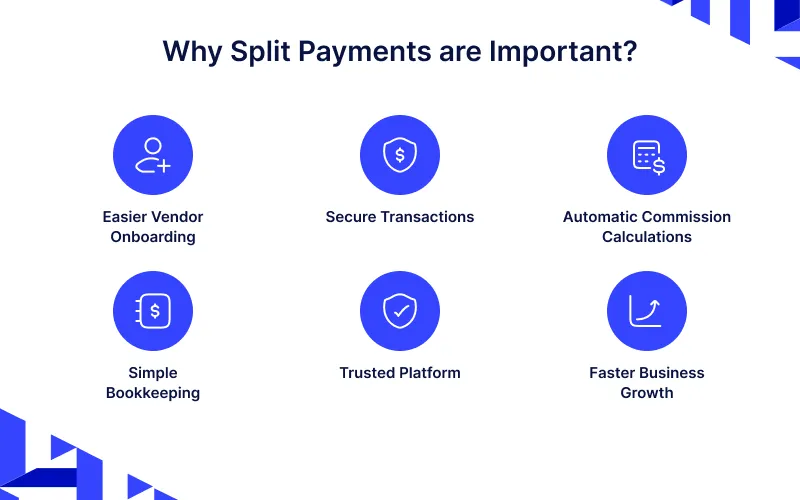
Why Split Payments Are Important
Split payments make marketplaces stronger. Benefits include:
- Easier vendor onboarding
- Secure transactions
- Automatic commission calculations
- Simple bookkeeping
- Trusted platform
- Faster business growth
Problems Without Split Payments
Without split payments, you may face several operational and financial challenges in your marketplace, such as:
- Slow payments to vendors
- Manual fund tracking
- More accounting mistakes
- Higher costs
- Unhappy sellers
Tips for Using Split Payments
Before starting, clearly define your commission structure and vendor payout rules.
Also, ensure your payment gateway supports automated split settlements and compliance requirements.
- Set commission rates
- Decide payout schedule
- Configure tax rules
- Set refund policies
- Enable vendor KYC
- Check payment reports often
A clear setup keeps your marketplace stable and ready to grow.
Final Thoughts
Split payments are really important for the payment systems we see in today’s multi-vendor marketplaces.
By automating how funds are distributed, we can make things clearer, work more efficiently, and help businesses grow in a way that can be expanded.
For long-term success, e-commerce marketplace platforms must include split payments.
They ensure secure transactions, build vendor trust, and support sustainable revenue management.


. . .

Be the first to comment.