Laravel Events and Listeners in Bagisto: How to Decouple Your Code
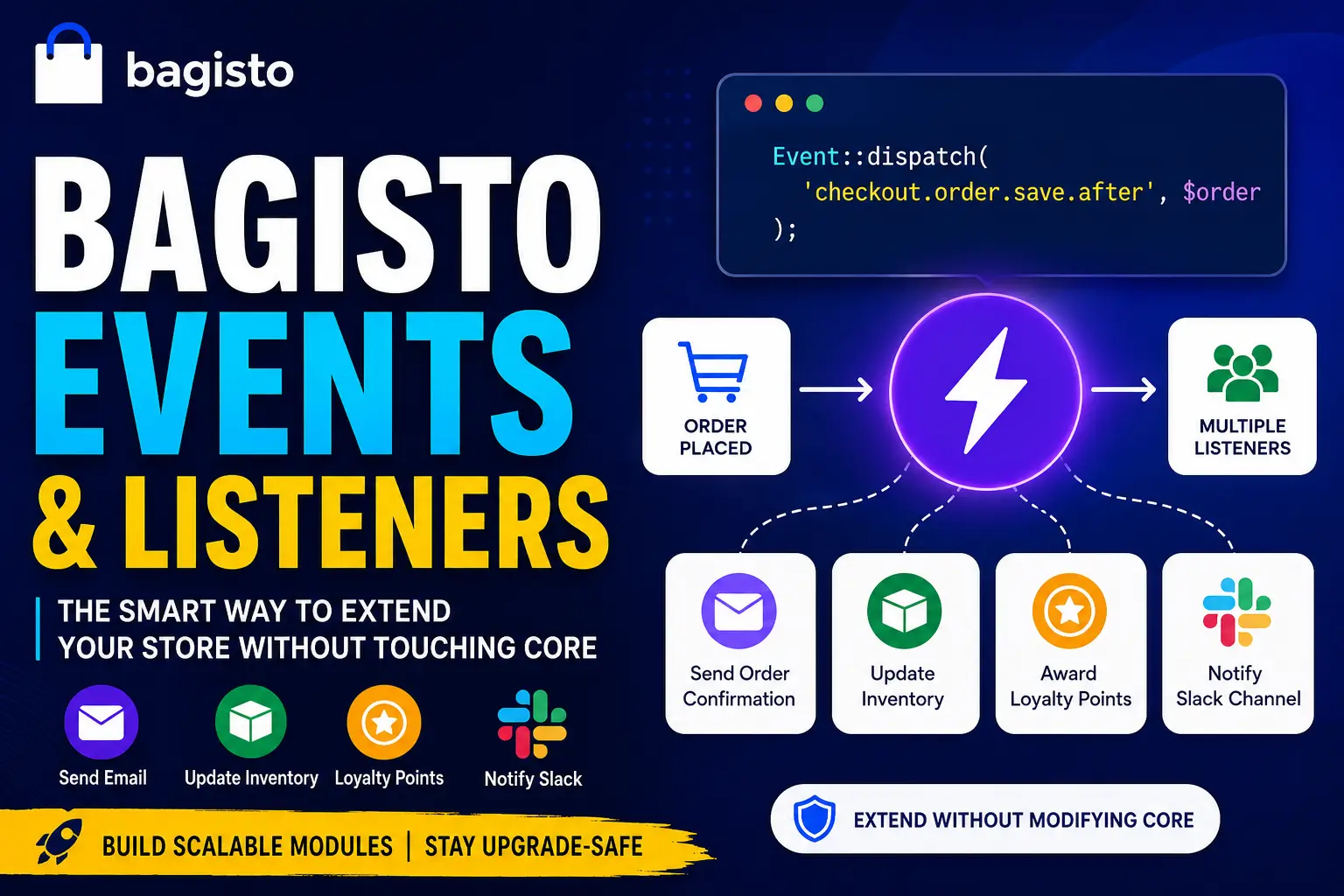
If you’ve spent any time customizing a Bagisto store, you’ve probably already brushed up against Bagisto events and listeners without fully realizing it.
Say you’re running a Bagisto store. A customer hits “Place Order.”
Now you need to send a confirmation email, update inventory, fire off an analytics ping, and maybe notify your fulfillment team in Slack.
Where does that logic live? If it’s all crammed into the checkout controller, you’ve got a problem.
That controller is now responsible for emails, inventory, analytics, and Slack, none of which have anything to do with actually placing an order.
This is the exact scenario Bagisto’s event system was built for.
Why Bagisto Events and Listeners Matter So Much
Bagisto isn’t just a Laravel app, it’s a collection of packages: Catalog, Sales, Checkout, Customer, and more.
These packages need to talk to each other without depending directly on each other.
Otherwise, installing a new extension could mean editing core files.
That’s exactly what you don’t want in an e-commerce platform people are constantly customizing.
A Real Example: Order Placement
When an order is saved during checkout, Bagisto dispatches an event before the save and another right after.
|
1 2 3 4 5 |
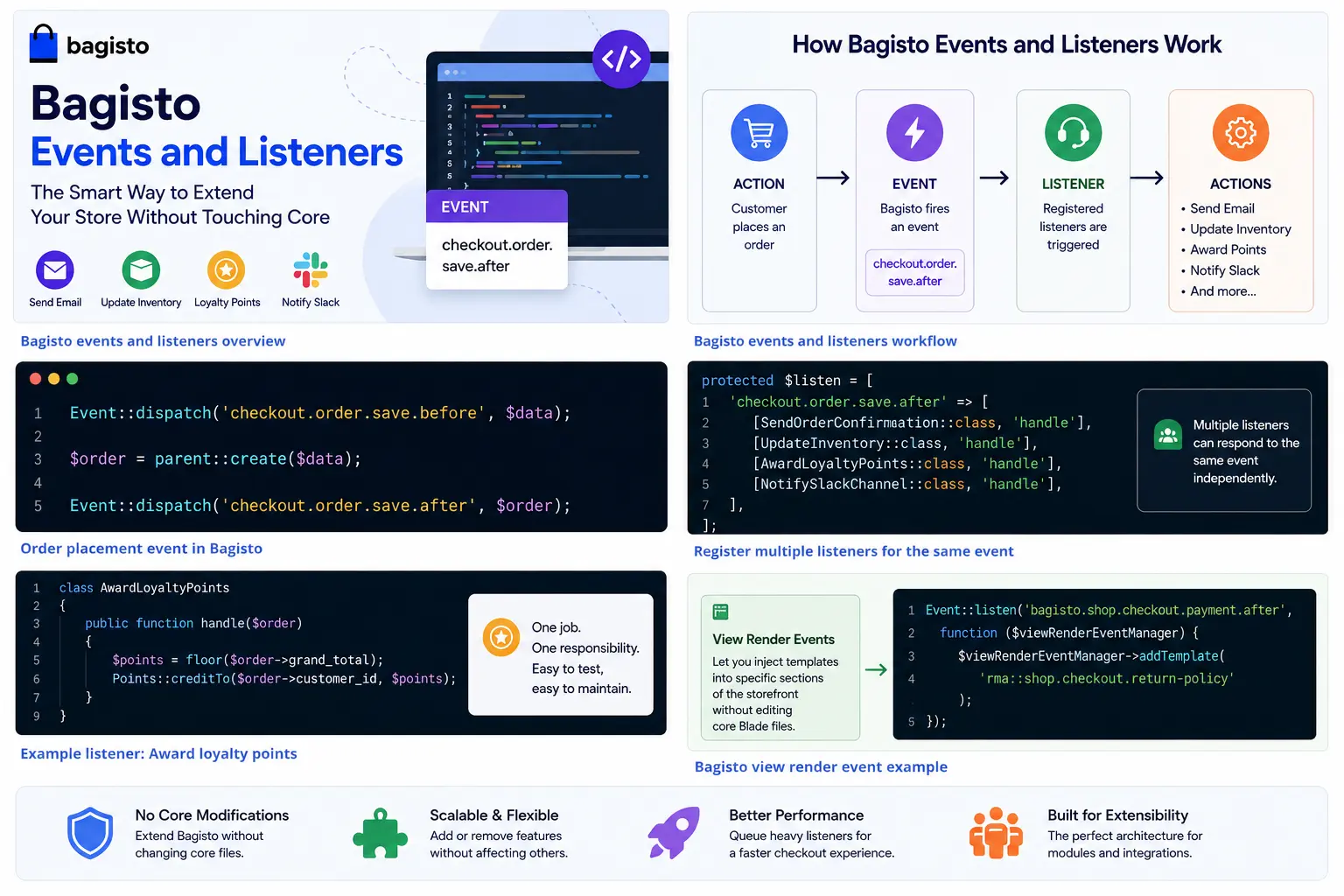
Event::dispatch('checkout.order.save.before', $data); $order = parent::create($data); Event::dispatch('checkout.order.save.after', $order); |
That checkout.order.save.after event is one of the most commonly used hooks in the entire platform.
It’s how the core itself sends the new-order email, and it’s how countless custom modules hook in to do their own thing once an order exists.
Listening Without Touching the Core
Here’s where it gets useful. Say you’re building a loyalty points module.
You don’t want to open up the Sales package and bolt your logic onto the order creation method.
Instead, you listen. This is where Bagisto events and listeners really earn their keep.
Letting your module react to core behavior without ever editing core code.
|
1 2 3 4 5 |
protected $listen = [ 'checkout.order.save.after' => [ [AwardLoyaltyPoints::class, 'handle'], ], ]; |
This goes in your own package’s EventServiceProvider. Bagisto’s core code never changes.
Update Bagisto to a new version, and your loyalty module keeps working, because it was never welded to the core in the first place.
|
1 2 3 4 5 6 7 8 |
class AwardLoyaltyPoints { public function handle($order) { $points = floor($order->grand_total); Points::creditTo($order->customer_id, $points); } } |
One job. One responsibility. Easy to test, easy to remove if a merchant decides they don’t want the feature anymore.
Stacking Multiple Listeners on One Event
Nothing stops you from having several packages listen to the same event independently.
|
1 2 3 4 5 6 7 8 |
protected $listen = [ 'checkout.order.save.after' => [ [SendOrderConfirmation::class, 'handle'], [UpdateInventory::class, 'handle'], [AwardLoyaltyPoints::class, 'handle'], [NotifySlackChannel::class, 'handle'], ], ]; |
Four completely separate concerns, four completely separate classes, none of them aware the others exist.
That’s the whole architecture working exactly as intended.
Don’t Forget View Render Events
Bagisto also has a second flavor of event built specifically for the frontend: view render events.
These let you inject markup into predefined spots across the storefront, like before or after the payment section at checkout.
Without touching a single Blade file in the core.
|
1 2 3 |
Event::listen('bagisto.shop.checkout.payment.after', function ($viewRenderEventManager) { $viewRenderEventManager->addTemplate('rma::shop.checkout.return-policy'); }); |
It’s the same philosophy applied to templates instead of logic. The core defines the moment, your package decides what happens at that moment.
Watch Your Listener Order and Weight
A couple of things worth knowing before you go wild with this.
Listeners on the same event run in the order they’re registered, so if one depends on another’s result, put the dependent one first.
Also, keep listeners lean. If your listener is calling an external API, sending email, or doing anything that could take more than a beat, queue it.
|
1 2 3 4 |
class SendOrderConfirmation implements ShouldQueue { // ... } |
A checkout flow that hangs while waiting on an SMTP server is a bad first impression for a new customer.
Final Thoughts on Bagisto Events and Listeners
Bagisto is meant to be extended, not edited.
Merchants install RMA modules, marketplace add-ons, loyalty systems, custom payment gateways, often all on the same store.
Often built by different developers who’ve never spoken to each other.
Bagisto events and listeners are the contract that makes that possible.
They let dozens of independent packages plug into the same checkout flow, the same order lifecycle.
The same customer journey, without ever stepping on each other’s toes.
If you’re building anything beyond the most basic customization, learning where Bagisto’s events fire, and how to listen to them properly.
Will save you from forking core files you’ll regret touching six months from now.
Thanks for reading this blog. Please comment below if you have any question.
Also you can hire laravel developers for your custom laravel projects.
Kindly explore our extensions.


Be the first to comment.