AI shopping agents now browse catalogs, compare prices, and start checkout for real buyers. So one question matters for every merchant: can these agents read your Bagisto store the way a shopper can?
Most store owners never test this. But agents judge a site in seconds, and one missing signal can drop you from their shortlist. This guide explains Bagisto agent readiness and shows how to check it fast.
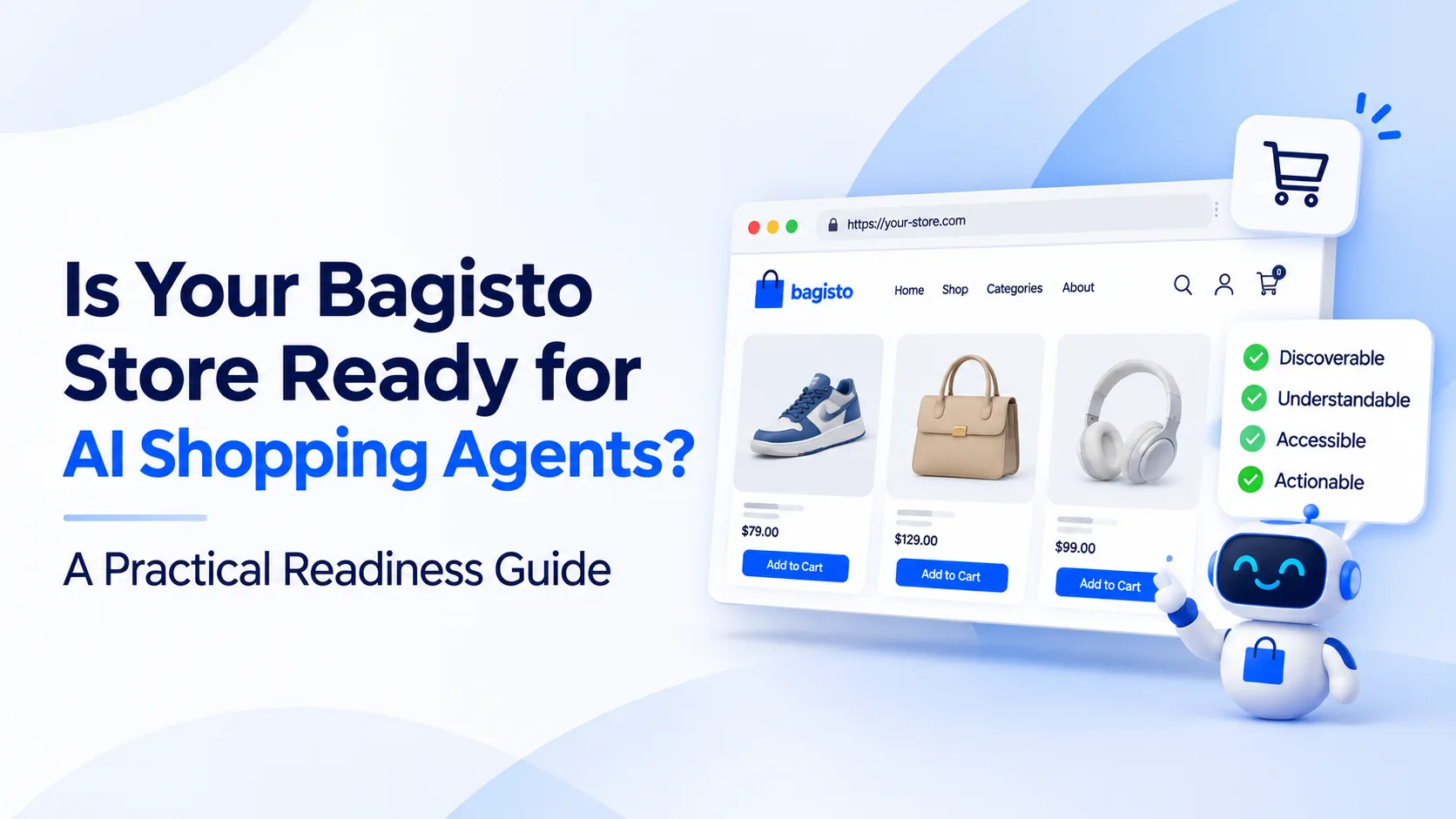

What are AI shopping agents?
An AI shopping agent is software that shops on behalf of a person. It reads product pages, pulls prices, and sometimes adds items to a cart without a human clicking.
These agents sit inside tools people already use. For example, a chat assistant can find a product, check stock, and suggest where to buy it.
So your store is no longer judged by humans alone. Machines now read your pages first, and they decide what to show the buyer next.
What does agent readiness mean?
Agent readiness is how easily a machine can understand and act on your store. A ready store sends clean data that an agent can trust without guessing.
Think of it as two layers. First, can the agent read your product name, price, and stock? Then, can it take an action, such as opening a cart link?
A human can forgive a messy layout. An agent cannot. If the price sits only inside JavaScript, many agents will miss it and move on.
So readiness is not about looks. It is about the raw bytes your server sends when an agent asks for a page.

How AI shopping agents read your store
Agents do not see your theme the way you do. Instead, they fetch the HTML, headers, and structured data your server returns.
They look for a few clear signals. For example, they check JSON-LD for the product name, brand, SKU, and price. They also test whether the add-to-cart control is a real labelled button.
Bagisto renders product pages on the server, which helps a lot. But it often skips identifiers such as brand, gtin, and aggregateRating that agents use to compare items.
So two Bagisto stores can look identical yet score very differently. The gap hides in the markup, not the design.
Why a Bagisto store needs a readiness check
You can read your own HTML by hand, but that takes hours and misses things. A checker does the same work in under a minute and shows the exact bytes.
Bagisto also emits its own signals that generic tools ignore. For instance, the generator meta tag, the bagisto_session cookie, and the Vite theme assets all confirm the platform.
A Bagisto-aware check reads those first. Then it tests the REST, GraphQL, and WebMCP routes an agent might call.
Meet the Bagisto AI agent checker
The Bagisto AI Agent Checker scores your store the way an agent sees it. You paste a store URL, and it fetches the public pages and grades what it finds.
The result is simple to read. You get a score from 0 to 100, a letter grade from A to F, and a tier such as Silver or Gold.
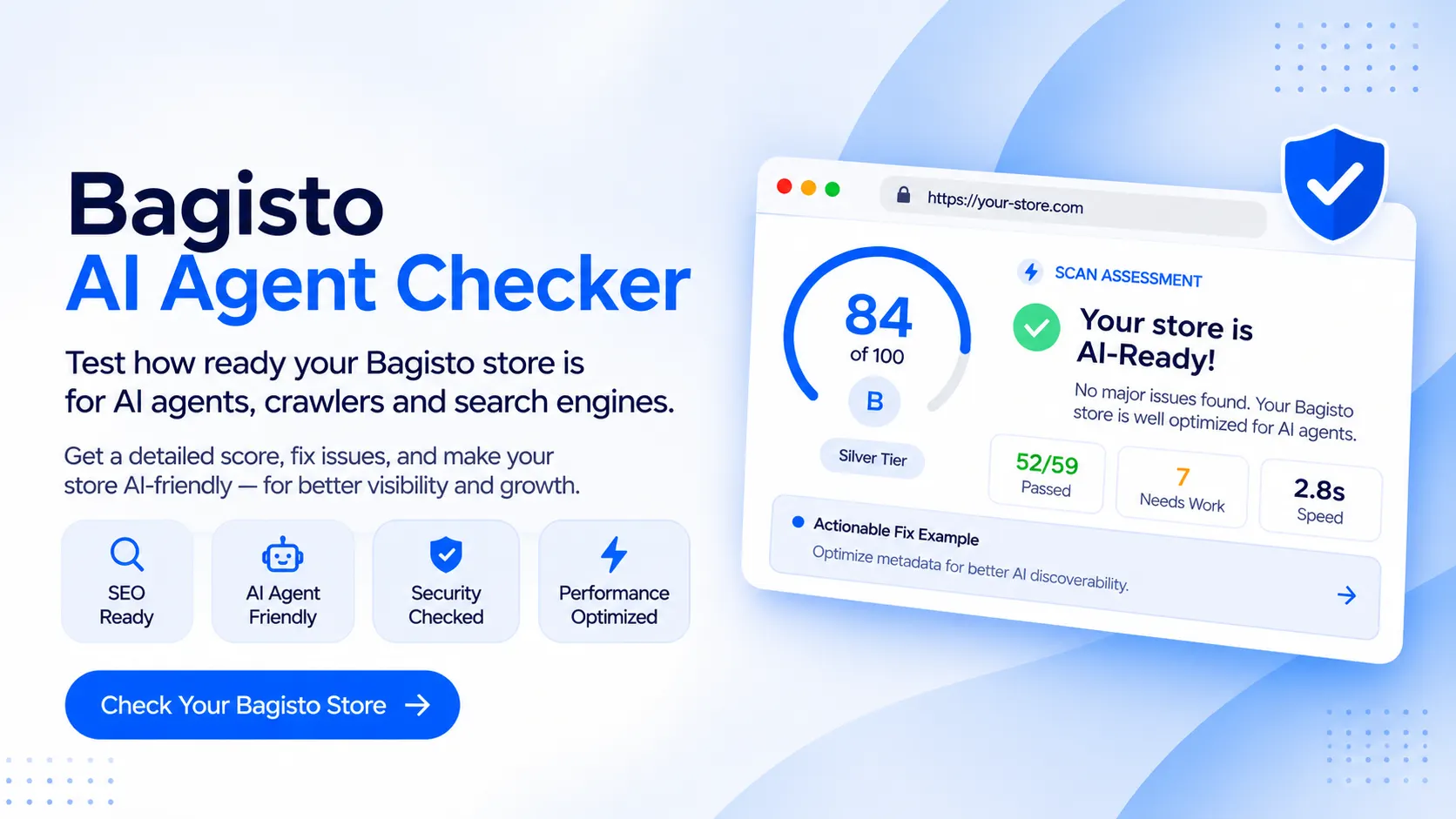
A sample scan returns 84 of 100 and a B grade. The readout says the catalog is readable, yet the machine cart endpoints are missing.
What the 74 checks cover
The tool runs 74 checks across ten categories. Together they map both Bagisto signals and universal crawler rules.
Here are the main groups it measures:
- Discoverability covers robots.txt, sitemaps, canonical URLs, and response speed.
- Structured data checks JSON-LD presence, valid schema, and the right types.
- Product data confirms name, price, stock, and variants sit in the served HTML.
- Operability tests add-to-cart, search, and variant pickers an agent can drive.
- Agentic commerce looks for cart permalinks, checkout, and policy discovery.
- Security reviews HTTPS, HSTS, CORS, and clickjacking headers.
The Bagisto Intelligence layer
Multiple of the checks focus only on Bagisto. This is the part generic scanners cannot do.
For example, it verifies server rendering versus client JavaScript, product identity fields, and configurable variant data. It also probes the Shop REST API, the GraphQL endpoint, and the WebMCP agent route.
So a rebranded store still gets flagged. The session cookie and Vue custom elements give the platform away.
Direct evidence, not guesswork
Every finding shows the real HTML, header, or file path the server returned. You can inspect the proof yourself instead of trusting a score.
If a bot wall or network block stops a test, the tool marks the item unverified rather than failed. So you never chase a problem that does not exist.
Fixes you can act on
A low score is only useful if you know the next step. Each failed check comes with clear remediation and a copy-ready prompt template.
Take the sample gap above. The tool tells you to publish a /.well-known/ucp profile to declare machine checkout and cart endpoints, which recovers about eight points.
How to use your results
Start with the gaps worth the most points. The report ranks them, so you fix the biggest wins first.
Next, hand the remediation steps to your developer or your Bagisto partner. The Bagisto team can also add the missing schema, endpoints, and signals for you.
Then rescan. A second scan confirms the fix landed and updates your grade.
Your quick readiness checklist
Run through these before you call your store agent-ready:
- Check that product name, price, and stock appear in the raw HTML.
- Add brand, SKU, gtin, and aggregateRating to your product JSON-LD.
- Make sure add-to-cart and search are real labelled controls.
- Publish a cart permalink and a /.well-known/ucp profile for agents.
- Confirm robots.txt and your sitemap do not block honest crawlers.
AI shopping agents are already reading stores and sending buyers elsewhere when the data is thin. A one-minute scan tells you where your Bagisto store stands today.
So test your store now, fix the top gaps, and scan again