A C2C marketplace lets people buy, sell, rent, or trade goods and services with each other online.

Platforms like OLX, eBay, Etsy, Facebook Marketplace, Depop, and Vinted follow this model in different ways.
Some focus on local selling, while others focus on resale, handmade goods, or niche communities.
To build one, you need more than a site where users post products. You need a proper marketplace platform with tools for buyers, sellers, and admins.
Buyers need confidence before paying. Sellers need simple tools to list and manage items.
Admins also need to manage users, listings, payments, reviews, and disputes.
Without these steps, the site gets hard to run as more users join.
This guide shows how to build a C2C marketplace site step by step.
It covers the model, key features, income options, costs, launch steps, and planning.
What Is a C2C Marketplace?
A C2C marketplace, also called a peer-to-peer site, lets people buy and sell directly with each other.
The platform usually does not own the products. It links buyers and sellers, runs the site, and sets rules for safer trades.
For example, one person may sell a used phone, handmade bag, old table, digital template, or local service.
Another person can search, compare, chat, pay, and complete the purchase.
The site can earn money through fees, listing charges, subscription plans, ads, or featured listings.
It also manages the systems that make buying and selling easier.
Good C2C software should handle the key tasks from one place.
That includes listings, buyer and seller accounts, payments, reviews, review checks, and admin tools.
Real-World Examples of C2C Marketplaces
Different C2C platforms solve different user problems. Studying them can help you plan your own platform with more clarity.
| Marketplace | Model | What You Can Learn |
| OLX | Local classifieds | Location search, direct chat, and simple listing creation matter. |
| eBay | Resale and auctions | Reviews, buyer safeguards, and payment security matter. |
| Etsy | Handmade goods | Seller profiles and product storytelling can improve conversions. |
| Facebook Marketplace | Local buying and selling | Easy discovery and local pickup can drive fast adoption. |
| Vinted / Depop | Fashion resale | Mobile experience, community, and seller reputation are important. |
These examples show that each site needs a clear niche, a simple flow, and a reason for users to return.
How Does a C2C Marketplace Work?
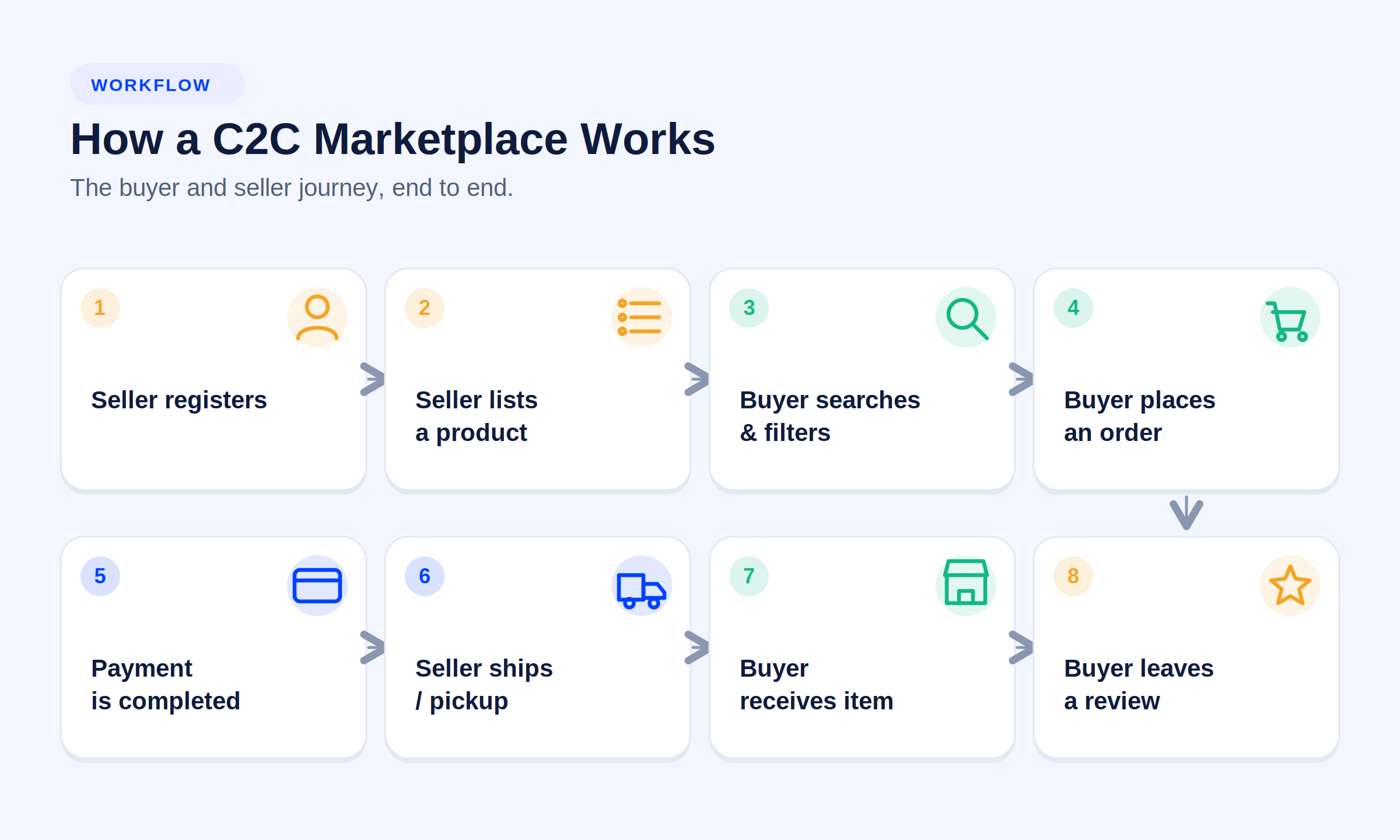

A C2C platform connects individual sellers with individual buyers.
The site helps users find items, chat, pay, leave reviews, and sometimes ship.
A simple workflow looks like this:
- Seller registers
- Seller lists a product
- Buyer searches or filters products
- Buyer contacts seller or places an order
- Payment is completed
- Seller ships the item or arranges pickup
- Buyer receives the product
- Buyer leaves a review
Here is a practical example.
A seller lists a used smartphone with photos, condition details, price, location, and delivery options.
A buyer finds it through filters and checks the seller’s rating.
The buyer asks a question through marketplace chat. After getting a clear answer, the buyer places the order and pays through the platform.
If escrow is enabled, the payment stays on hold until delivery is confirmed. Once the buyer receives the phone, they leave a review for the seller.
This is why search, chat, safe payments, ratings, product details, and dispute handling sit at the core.
Key Participants in a C2C Marketplace
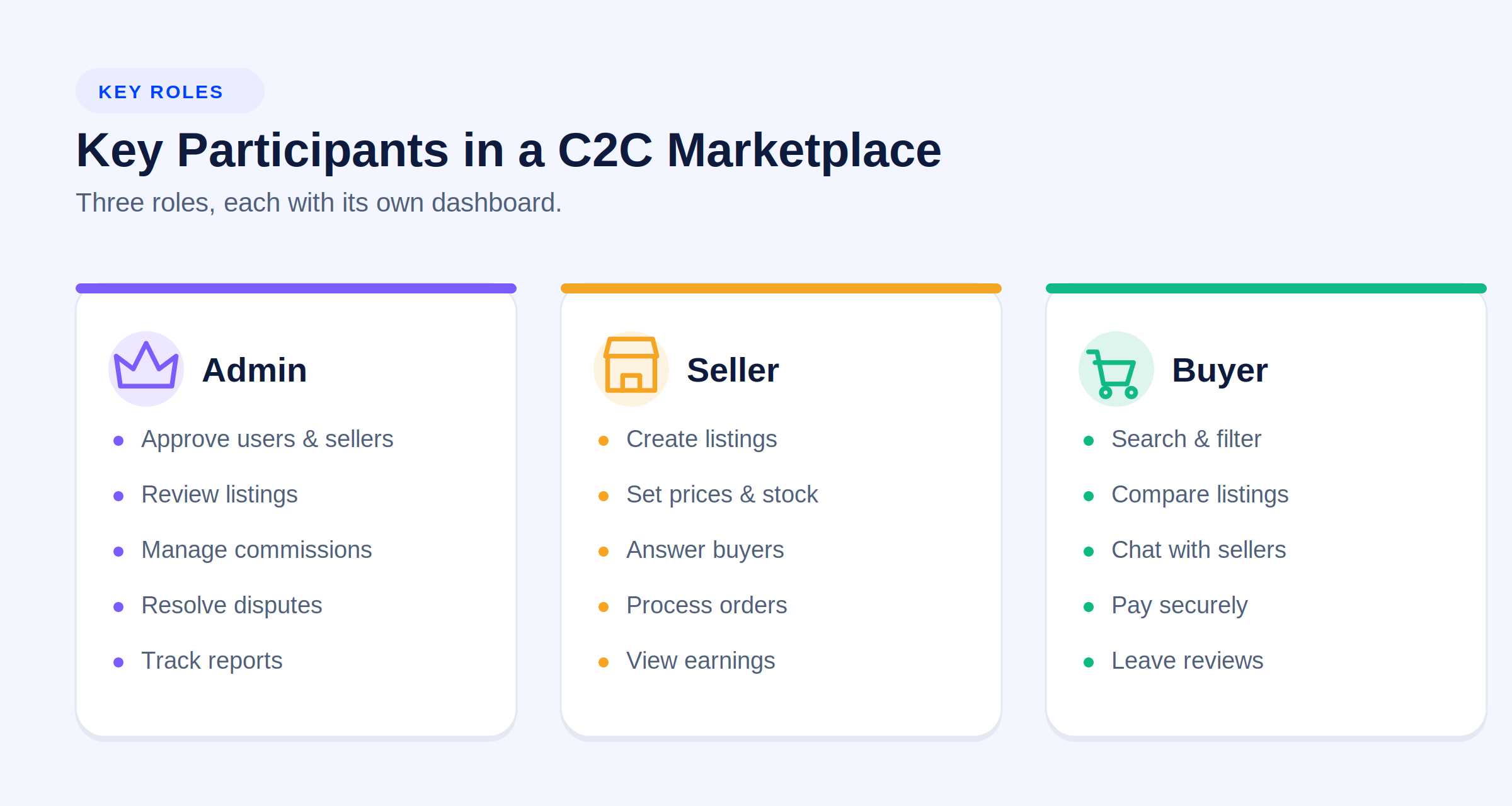

A C2C marketplace usually has three main user roles: admin, seller, and buyer. Each role needs a different dashboard and workflow.
Admin
The admin owns and manages the marketplace.
They approve users, check listings, set fees, track payments, settle disputes, and enforce rules.
Admins also need reports on orders, income, active sellers, top products, refunds, growth, and risk.
Seller
Sellers open accounts, add products, set prices, manage stock, answer buyers, and fill orders.
A good seller dashboard should work without admin help for routine tasks.
With the right seller dashboard, sellers can manage listings, inventory, earnings, messages, shipping status, and reviews on their own.
Buyer
Buyers search, compare, contact sellers, place orders, pay, track delivery, and leave reviews.
Their journey should feel simple. If search, payment, or chat feels hard, many buyers leave before they finish the order.
Popular Types of C2C Marketplaces
Your site type shapes its features, payment methods, shipping, checks, and marketing.
A local resale platform is different from a handmade goods site.
| Marketplace Type | Common Use Cases |
| Second-hand marketplace | Used phones, laptops, furniture, books |
| Fashion resale marketplace | Clothes, shoes, bags, accessories |
| Handmade marketplace | Crafts, artwork, gifts, home decor |
| Rental marketplace | Bikes, tools, equipment, vehicles |
| Local marketplace | Community buying and selling |
| Digital marketplace | Templates, e-books, digital assets |
| Services marketplace | Tutoring, freelancing, consulting |
| Classified marketplace | Local listings and offline deals |
It is easier to grow supply, build trust, and draw the right buyers when the site does not sell everything at once.
A fashion-focused resale site, for instance, can build on a dedicated fashion commerce setup.
C2C Marketplace vs B2C Marketplace
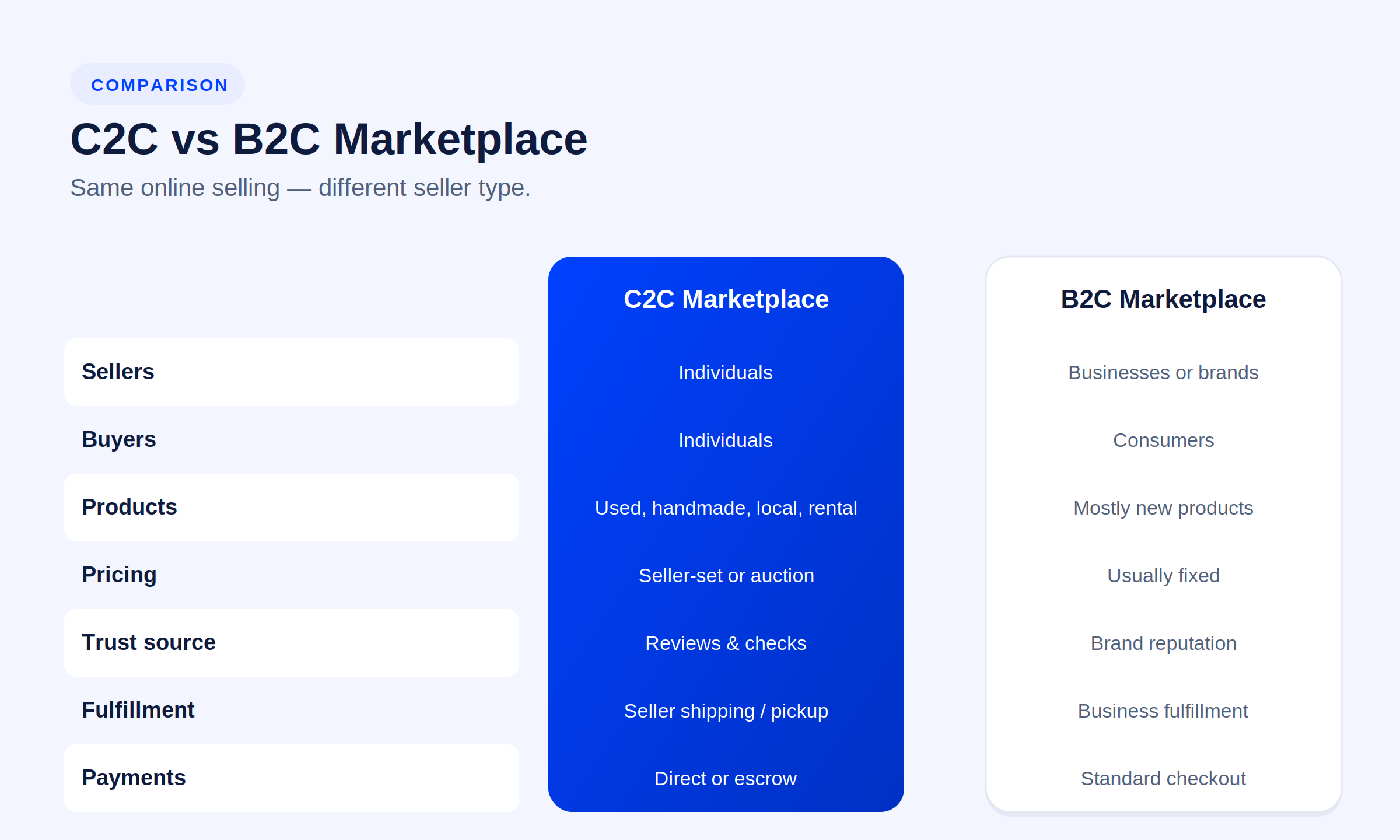
C2C and B2C marketplaces both support online selling, but the seller type is different.
In a C2C marketplace, individuals sell to other individuals. In a B2C marketplace, businesses sell to consumers.
A C2C model works well for resale, local commerce, rentals, handmade goods, collectibles, and peer-to-peer services.
A B2C model works better when businesses manage inventory, pricing, fulfillment, and customer support directly.
If your sellers are businesses rather than individuals, a B2B marketplace model is a closer fit.
Why Build a C2C Marketplace?
A C2C marketplace can grow without the owner buying or storing inventory.
Sellers bring the products, while the site handles the tech, rules, and growth.
Lower Inventory Cost
Site owners do not need to buy, store, or manage every product. Sellers handle their own listings, prices, stock, and fulfillment.
This helps startups that want to launch an online store without warehouse costs.
Larger Product Catalog
Every new seller can add new products. This helps the catalog grow naturally over time.
For example, a local furniture resale platform can start with a few trusted sellers and expand as more users list chairs, tables, beds, and home decor.
Multiple Revenue Streams
A C2C site can earn from fees, featured listings, plans, ads, sale charges, or paid memberships.
Most sites start with one simple model and add more income options later as traffic grows.
Strong Community Value
C2C platforms work well when users return often. Buyers come back for new listings, price drops, saved searches, and trusted sellers.
Sites with strong communities also grow through reviews, referrals, repeat sellers, and word of mouth.
Sustainable Commerce
Many C2C marketplaces support reuse and resale. This helps extend product life and reduce waste.
Fashion resale, used electronics, furniture resale, and second-hand book platforms all serve buyers who want value and sustainability.
How to Build a C2C Marketplace Website Step by Step
Building a marketplace is not just a tech project.You need to plan the model, user flow, payment steps, review rules, and launch.
1. Choose a Focused Marketplace Niche
Start with one clear niche. Avoid launching a platform that tries to cover every category at once.
Good niches include used phones, fashion resale, handmade goods, furniture, books, baby items, sports gear, or rentals.
A focused niche helps you understand buyer behavior. It also makes marketing, seller sign-up, listing checks, and support easier.
For example, a used phone site needs grading, fraud checks, and safe delivery.
A handmade marketplace needs seller profiles and product storytelling.
2. Define the Marketplace Model
Decide how buyers and sellers deal with each other. Your model shapes payments, shipping, chat, checks, and admin control.
Common models include:
- Local classifieds
- Managed marketplace
- Vertical marketplace
- General marketplace
- Rental marketplace
- Digital goods marketplace
- Service marketplace
A classified platform gives users more freedom but less platform control.
A managed site gives the admin more control over payments, orders, refunds, and disputes.
| Feature | Managed Marketplace | Classified Marketplace |
| Payments | Processed on platform | Often handled by users |
| Orders | Managed online | Often completed offline |
| Shipping | Platform-supported | Seller-managed |
| Buyer protection | Stronger | Limited |
| Admin control | Higher | Lower |
| Best for | Ecommerce-style transactions | Local buying and selling |
If payment safety and order tracking matter in your niche, a managed model is usually better.
3. Choose a Revenue Model
Your income model should make sense for both sellers and buyers. If fees feel unfair, sellers may avoid the platform.
Common options include:
| Revenue Model | How It Works |
| Commission | Platform earns a percentage from each sale. |
| Featured listings | Sellers pay to promote products. |
| Seller subscription | Sellers pay monthly or yearly for extra benefits. |
| Transaction fee | Platform charges a fixed fee per order. |
| Advertising | Brands or sellers pay for ad placements. |
| Premium membership | Users pay for extra features. |
| Hybrid model | Platform combines two or more revenue streams. |
For most new C2C sites, fees and featured listings are easy to grasp.
Subscriptions work better when sellers are active and receive clear value.
4. Select the Right Marketplace Platform
Choose a platform that fits marketplace tasks, not just plain online selling.
Your platform should support the full marketplace workflow.
This covers users, listings, buyer and seller dashboards, orders, fees, payments, shipping, reviews, and reports.
Also check whether the platform can support custom features later.
Many C2C sites need seller ID checks, escrow, chat, wallets, dispute tools, and mobile apps.
If you are exploring a Laravel-based setup, Bagisto’s Laravel ecommerce platform can be a flexible base for custom ecommerce and marketplace workflows.
5. Plan the Buyer and Seller Journey
Before development starts, map the full journey for each user.
On the seller side, plan how they sign up, verify, list items, add images, handle orders, get paid, and reply to reviews.
For buyers, meanwhile, map how they search, filter, compare, contact sellers, pay, track orders, ask for refunds, and rate.
Admins also need a clear path: plan how they approve sellers, check listings, handle payments, settle disputes, and track results.
This step prevents confusion later. A clear journey helps your team build the right features in the right order.
6. Build the Core Marketplace Features
Do not start with every advanced feature. Build the core features needed to complete a safe transaction.
Important features include:
- Buyer registration
- Seller registration
- Seller dashboard
- Product listings
- Product categories
- Search and filters
- Product images
- Messaging
- Secure payments
- Order management
- Ratings and reviews
- Notifications
- Admin dashboard
- Commission management
- Refund and dispute process
These features allow buyers and sellers to complete the basic marketplace workflow.
Extra features like wallets, loyalty perks, AI tips, and mobile apps can come later.
7. Add Secure Payments
Payments are one of the most sensitive parts of a C2C platform. Buyers often pay people they do not know, so the payment flow must feel safe.
Common payment options include cards, wallets, bank transfers, a site wallet, and escrow.
Escrow is useful when buyers need extra confidence. The platform can hold payment until the order is delivered or confirmed.
Also plan seller settlements. Sellers should know when they get paid, what fee is taken, and how refunds work.
8. Add Verification, Reviews, and Moderation
In peer-to-peer commerce, users often buy from strangers.That makes checks, reviews, payment cover, and dispute handling part of the core product.
Important safety controls include:
- Email checks
- Phone checks
- Seller approval
- Identity checks
- Product review
- Ratings and reviews
- Reporting abuse
- Secure payments
- Dispute resolution
- Clear platform policies
For high-value items like phones, luxury goods, or collectibles, you may need stronger checks.
9. Test, Launch, and Improve
Test every workflow before launch. A small bug in sign-up, payment, chat, or order tracking can hurt trust fast.
Start with a small group of sellers. Ask them to list products, process test orders, and share feedback.
Then invite early buyers. Watch where they drop off, what they ask, and which listings draw the most interest.
A good C2C platform improves through real user behavior. Launch with the core flow, learn from users, and keep improving.
Essential Features of a C2C Marketplace Platform
The right features help users buy, sell, chat, and finish trades without confusion.
| Feature | Why It Matters |
| Seller dashboard | Lets sellers manage listings, orders, and earnings. |
| Buyer dashboard | Lets buyers track orders, reviews, and saved products. |
| Product listings | Gives buyers clear details before purchase. |
| Search and filters | Helps buyers find relevant items faster. |
| Messaging | Lets buyers and sellers ask questions safely. |
| Ratings and reviews | Builds seller reputation over time. |
| Secure payments | Reduces payment risk. |
| Shipping integration | Helps sellers manage delivery. |
| Returns and refunds | Reduces purchase hesitation. |
| Notifications | Keeps users updated. |
| Reports and analytics | Gives admins better control. |
| Mobile-friendly design | Supports users who browse and sell from phones. |
Seller Dashboard
The seller dashboard should be simple. Sellers need to add products, edit listings, check orders, update shipping, view earnings, and respond to buyers.
If the dashboard is hard to use, sellers may stop listing products. This reduces supply and slows platform growth.
Buyer Dashboard
Buyers need one place to manage orders, saved items, messages, reviews, addresses, returns, and account details.
A clean buyer dashboard reduces support requests and makes repeat purchases easier.
Product Listings
Each listing should show the title, images, details, price, type, condition, location, stock, and delivery options.
For used products, condition details matter a lot. A listing should say if the item is new, used, refurbished, damaged, or missing parts.
Search and Filters
Search should help buyers find products quickly. Handy filters include type, price, location, condition, seller rating, brand, and delivery.
For an OLX-style local platform, location filters are critical. Many buyers want nearby sellers for pickup or lower delivery cost.
Messaging System
Messaging is useful because C2C buyers often have questions before purchase.
They may want to confirm product condition, negotiate price, ask for more photos, or discuss pickup time.
Built-in messaging also protects privacy. Users do not need to share personal phone numbers too early.
Ratings and Reviews
Reviews help buyers judge seller reliability. They also encourage sellers to describe products honestly and complete orders properly.
Platforms like eBay and Etsy show why seller reputation matters. A seller with strong ratings can earn more buyer confidence over time.
Notifications
Users should receive updates when important actions happen.
Common alerts cover new messages, order updates, paid orders, shipping news, refund status, review asks, and price drops.
Secure Payments
Safe payment methods lower risk for both buyers and sellers.The site should show clear payment status, past orders, and refund rules.
If escrow is used, explain how the money is held and when it is released to the seller.
Shipping and Pickup Options
Some C2C platforms need shipping. Others rely on local pickup. Many need both.
Shipping tools may cover rate quotes, courier links, labels, tracking, and delivery alerts.
For local platforms, allow pickup location, pickup time, and buyer-seller coordination through chat.
Returns and Refunds
C2C returns can be more complex than standard ecommerce returns. Sellers may not offer the same policies as businesses.
Set clear rules before launch. Explain when refunds are allowed, who pays return shipping, and how disputes are reviewed.
Reports and Analytics
Admins need data to manage growth and reduce risk.
Useful reports cover orders, income, active users, top types, top products, dispute rates, refund rates, and seller results.
Mobile Experience
Many users will browse, chat, and upload products from mobile phones.
A responsive website is the minimum. A mobile app can come later if your site relies on frequent browsing, chat, and alerts.
Safety and Moderation Features Every C2C Marketplace Needs
C2C sites deal with everyday users. That makes safety, checks, and clear rules key from the start.
User Verification
Start with email and phone verification. Add ID checks if your site handles pricey items, rentals, or regulated goods.
Verification reduces fake accounts and gives buyers more confidence.
Seller Approval
Not every user should become a seller instantly. Check seller details before you let them post listings, mostly during early launch.
This helps protect platform quality and reduces spam listings.
Product Moderation
Review listings before or after they go live. Remove fake, duplicate, prohibited, counterfeit, or misleading products.
Checks matter for items like phones, branded goods, tickets, collectibles, and digital products.
Fraud Detection
Watch for red flags: duplicate accounts, fake reviews, failed payments, stolen images, spam listings, and odd refunds.
Even basic monitoring can help detect risks before they harm users.
Reporting Abuse
Users should be able to report fake products, fraud, spam, offensive content, or policy violations.
The admin team should have a clear process to review and act on reports.
Dispute Resolution
Disputes are common in peer-to-peer commerce. A buyer may say the product is damaged, fake, delayed, or different from the listing.
A fair process lets both sides submit proof. The admin can then refund, release payment, or ask for more details.
Marketplace Policies
Publish clear rules before launch.
Clear rules cover banned products, buyer and seller duties, payment terms, refunds, disputes, privacy, and conduct.
Clear policies reduce confusion and make admin decisions easier.
Revenue Models for a C2C Marketplace
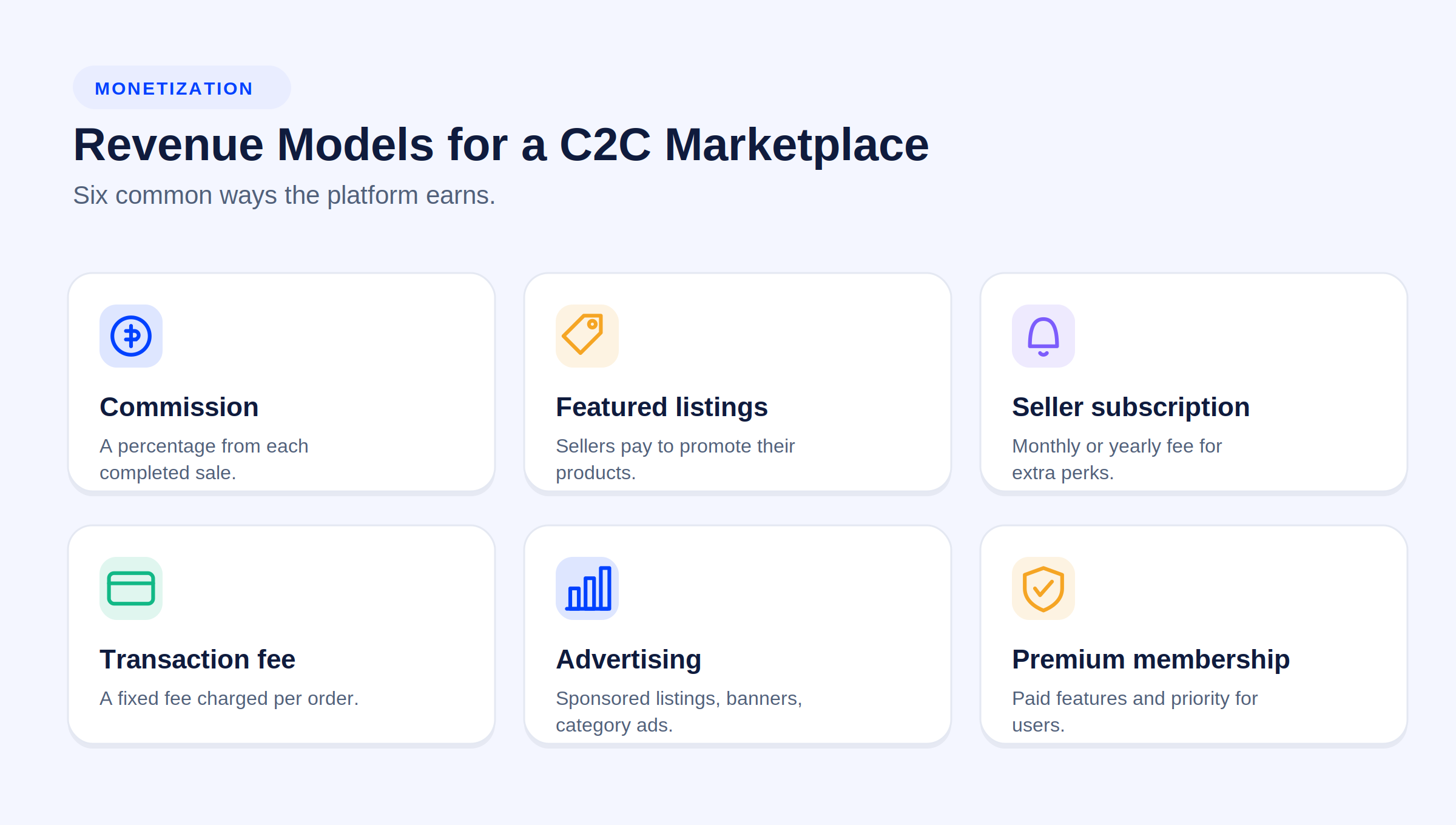

There is no single best revenue model. The right choice depends on your niche, sale value, seller activity, and how much control you want.
Commission Model
The platform earns a percentage from each completed sale.
This model works well for ecommerce-style transactions where payment happens through the platform.
Featured Listings
Sellers pay to show products higher in search results or category pages.
This works well when the platform has enough traffic and many active listings.
Seller Subscription
Sellers pay a monthly or yearly fee for extra benefits.
Perks may include more listings, seller badges, lower fees, better reach, or richer stats.
Transaction Fee
The platform charges a fixed fee per completed order.
This is easy for sellers to understand and can be combined with a small commission.
Advertising
The platform shows sponsored listings, banners, or category ads.
Advertising works better after the platform has steady traffic and a clear audience.
Premium Membership
Users pay for extra features such as early access to listings, lower fees, saved search alerts, or priority support.
This works best when the paid features offer clear value.
Hybrid Revenue Model
Many growing platforms combine more than one model.
For example, a platform may charge commission on sales and also offer featured listings for sellers who want more visibility.
How Much Does It Cost to Build a C2C Marketplace?
The cost depends on the platform, design, features, add-ons, security needs, and custom work.
A simple MVP costs less than a custom site with escrow, mobile apps, AI tips, a wallet, and rich dispute tools.
Key cost factors include:
- Marketplace platform
- UI and UX design
- Seller dashboard
- Buyer dashboard
- Product catalog
- Search and filters
- Payment integration
- Shipping integration
- Messaging
- Reviews
- Admin dashboard
- Security features
- Hosting and maintenance
- Mobile app development
- Ongoing support
Do not plan only for development cost. Also plan for hosting, security updates, bug fixes, marketing, seller sign-up, and support.
A flexible platform cuts long-term cost, since you can add features without rebuilding it all.
Common Mistakes to Avoid
Many C2C sites fail because they focus on tech alone and ignore supply, demand, user habits, and control.
Starting Too Broad
Do not launch with too many categories. It becomes hard to manage sellers, listings, reviews, and marketing.
Start with one niche, validate demand, then expand.
Ignoring User Safety
Buyers may not purchase from strangers unless the platform gives them enough confidence.
Verification, reviews, secure payments, reporting, and dispute resolution should be planned early.
Weak Seller Onboarding
If sellers do not understand how to list products, upload images, price items, or manage orders, supply will stay low.
Create a simple onboarding flow and clear seller guidelines.
Poor Product Discovery
If buyers cannot find relevant products fast, they will leave.
Use clean categories, filters, search, location sorting, and product recommendations.
Limited Payment Options
Offer payment methods that match your users and region.
For some niches, escrow or wallet support may be more important than standard checkout.
No Clear Refund Rules
Without clear refund rules, disputes become stressful for buyers, sellers, and admins.
Explain refund conditions, timelines, evidence requirements, and admin review process.
Ignoring Mobile Users
Many C2C users list and browse products from phones.
Optimize listing creation, image upload, chat, search, checkout, and notifications for mobile users.
Weak Listing Moderation
Spam, fake products, and poor listings can damage platform quality.
Set moderation rules early and give users an easy way to report suspicious listings.
Depending Only on Paid Ads
Paid ads bring traffic, but growth also needs SEO, referrals, seller deals, social media, and community.
Build content around your niche, product categories, buyer guides, and seller tips.
Can Bagisto Be Used to Create a C2C Marketplace Platform?
Yes, Bagisto can be used as a foundation for a C2C marketplace, but it needs custom development for peer-to-peer workflows.
Bagisto already provides a strong ecommerce base.
It covers the product catalog, customers, orders, payments, shipping, tax, many channels, and many currencies.
For a C2C platform, you may need extra custom features.
These include seller approval, product checks, fee logic, chat, a seller dashboard, held payments, and disputes.
This makes Bagisto useful if you want an open-source and flexible system instead of a closed marketplace builder.
If your project needs many sellers on one storefront, you can also explore Bagisto’s Laravel Multi Vendor Marketplace Platform.
For extension-level functionality, Bagisto’s Laravel Multi Vendor Marketplace Extension is a relevant internal resource.
If you want to understand the wider multi-seller model, Bagisto also has a guide on how to create a multi vendor marketplace.
For custom implementation needs, Bagisto’s eCommerce services page can be linked as a marketplace development resource.
Why Bagisto Works for Custom Marketplace Development
Bagisto is built on Laravel, which gives developers control over custom workflows.
This is useful because every C2C marketplace works differently.
A local classifieds site does not need the same flow as a handmade goods or fashion resale platform.
With custom work, Bagisto can support different site models, income rules, seller rights, payment flows, and add-ons.
A C2C store built on an open-source base also gives firms more control over code, data, and future changes.
Useful Bagisto Customizations for C2C
Common customizations include:
- Seller registration
- Seller approval
- Seller dashboard
- Product approval
- Commission management
- Buyer-seller messaging
- Wallet or escrow flow
- Ratings and reviews
- Dispute management
- Product reporting
- Mobile app support
- Shipping integrations
- SMS and email notifications
- Analytics and reports
If you need a ready-made C2C platform with no custom work, Bagisto may not be enough by itself.
But if you want flexibility, ownership, and room to scale, it can be a strong base for custom marketplace development.
C2C Marketplace Launch Checklist
Before launch, test the platform from the view of buyers, sellers, and admins.
Buyer Checklist
Make sure buyers can:
- Register an account
- Search products
- Use filters
- View seller profiles
- Send messages
- Place orders
- Complete payment
- Track delivery
- Request refunds
- Leave reviews
Seller Checklist
Make sure sellers can:
- Register successfully
- Complete checks
- Create listings
- Upload images
- Set prices
- Manage inventory
- Respond to messages
- Process orders
- Update shipping status
- View earnings
- Manage reviews
Admin Checklist
Make sure admins can:
- Approve sellers
- Review listings
- Manage users
- Set commissions
- Monitor payments
- Resolve disputes
- Process refunds
- Handle reports
- View analytics
- Manage policies
Technical Checklist
Review the technical setup before launch.
- SSL certificate enabled
- Mobile responsive design
- Fast page loading
- Secure login
- Payment testing
- Email notifications
- Error logging
- Backup system
- Security monitoring
- Performance testing
Marketing Checklist
Prepare a launch plan before inviting users.
- SEO pages
- Category pages
- Seller guides
- Social media profiles
- Referral program
- Email campaigns
- Community outreach
- Early seller onboarding
- Launch offers
Start with a small group of trusted sellers and early buyers. Fix problems before scaling to more users and categories.
Final Thoughts
Building a C2C marketplace website is about more than connecting buyers and sellers.
The real challenge is creating a platform where people feel confident trading with others they do not know.
Start by choosing a niche and business model. Then map the buyer-seller flow.
Add core features, secure payments, ID checks, and reviews. Finally, test the full order flow before launch.
As the site grows, you can add features like escrow, wallets, mobile apps, smart tips, seller plans, and deeper stats.
Bagisto can be a flexible open-source base for a C2C platform.
It can be customized to support marketplace workflows, seller management, payments, reviews, and long-term growth.
Frequently Asked Questions
What is a C2C marketplace?
A C2C marketplace is an online platform where individuals buy and sell products or services directly with each other.
The site links users, runs listings, supports chat, and may also handle payments, reviews, refunds, and disputes.
How do I build a C2C marketplace website?
Start by choosing a niche and business model.
Then plan the buyer and seller flow, add core features, and enable secure payments. Finally, add checks and reviews, and test the full order flow.
Start with an MVP. Launch with a small group of users, collect feedback, and improve the platform over time.
What features are needed in a C2C marketplace platform?
Key features include seller and buyer sign-up, product listings, search filters, and messaging.
You also need secure payments, ratings, reviews, order management, disputes, and admin controls.
Depending on your niche, you may also need escrow, local pickup, shipping integration, seller verification, wallet support, or mobile apps.
What is the difference between C2C and B2C marketplace?
In a C2C marketplace, individuals sell to other individuals. In a B2C marketplace, businesses or brands sell to consumers.
C2C sites lean on reviews, checks, payment cover, and clear rules, since users often buy from strangers.
How does a C2C marketplace make money?
A C2C marketplace can earn in several ways.
Options include commissions, featured listings, seller subscriptions, transaction fees, advertising, premium memberships, or a hybrid model.
The best model depends on your niche, seller activity, transaction value, and platform maturity.
What are some examples of C2C marketplaces?
Popular examples include OLX, eBay, Etsy, Facebook Marketplace, Depop, Vinted, and OfferUp.
Each platform uses a different model, but all connect individual sellers with individual buyers.
How can a C2C marketplace prevent fraud?
A platform can reduce fraud in several ways.
These include ID checks, seller approval, secure payments, escrow, product review, reporting tools, and a clear dispute process.
Fraud prevention should be planned before launch, not added only after problems appear.
Should I build a C2C marketplace website or mobile app first?
For most new marketplaces, a responsive website or MVP is the better first step. It is faster to launch and easier to test.
Once you validate buyer and seller activity, you can build mobile apps for better chat, notifications, and repeat usage.
Can Bagisto be used to create a C2C marketplace?
Yes, Bagisto can be customized to create a C2C marketplace.
It provides ecommerce features such as product catalog, orders, payments, shipping, customers, and multi-channel support.
For C2C use cases, you may need custom features like seller approval, product moderation, messaging, escrow, seller dashboard, reviews, and dispute management.
What is the biggest challenge in building a C2C marketplace?
The biggest challenge is growing both buyers and sellers while keeping the platform reliable.
A site needs enough sellers to draw buyers and enough buyers to keep sellers active.
Clear niche focus, simple workflows, and strong moderation help solve this problem.

